
One in three Southeast Asians open to buying EVs

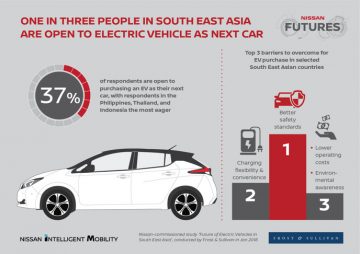
One in three Southeast Asian consumers planning to buy a car are open to purchasing an electric vehicle, a study shows.
The finding demonstrates the region’s strong potential to speed up mobility electrification.
The Nissan-commissioned study by Frost & Sullivan, titled “Future of Electric Vehicles in Southeast Asia”, was released in Singapore at Nissan Futures, a gathering of industry leaders, government officials and media from February 5-7.
At the same event Nissan announced it will launch its new Leaf in Australia, New Zealand, Hong Kong, Malaysia, Singapore, South Korea and Thailand during the 2018-2019 financial year.
Meanwhile, consumer research in Singapore, Indonesia, Thailand, Malaysia, Vietnam and the Philippines reveals that 37% of prospective buyers are open to considering an electric vehicle as their next car.
Customers in the Philippines, Thailand and Indonesia are the most enthusiastic.
With the right incentives, the region can accelerate the adoption of electric and electrified vehicles, the study shows.
Across the region, two out of three consumers identified safety standards as the most important factor if purchasing an electric vehicle.
Charging convenience is the second-most important.
Contrary to common perception, cost is not a deterrent. In fact, customers surveyed were willing to pay more to own an electric vehicle, compared with a comparable conventional car.
However, the study shows that lower costs will prompt more people to consider electric cars.
Three in four respondents say they are ready to switch to electric vehicles if taxes are waived.
Other incentives that would sway consumers include the installation of charging stations in apartment buildings (70%), EV priority lanes (56%) and free parking (53%).
While electric car ownership in Southeast Asia is still relatively low, the survey shows that consumers are aware of differences among technologies such as battery electric vehicles (BEVs, which had 83% recognition), plug-in hybrids and Nissan’s e-Power vehicles.
Singapore, Indonesia and Vietnam are most evolved in their understanding of BEVs. A significant presence of full hybrids in Malaysia and Thailand skews association of EVs with hybrids there.
However, a lack of knowledge is included in adoption barriers.
Range anxiety is the main one, and customers are also unsure about EV safety standards.
“Consumers in Southeast Asia have indicated that governments have a critical role to play in the promotion of electric vehicles,” Nissan regional senior vice-president Yutaka Sanada says.
“Meanwhile, as car manufacturers, we need to do a better job in explaining that EVs are indeed a safe, smart and sustainable option in all weather conditions.”

Join the conversation