
One man’s vision: Tesla taxis
This story first appeared in the December issue of EVtalk – CLICK HERE to download the magazine FREE
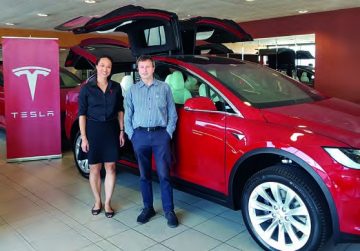
Bernard Bromell and Tesla NZ delivery operation specialist Ange Taylor.
If you want to do something about climate change and sustainability, just do it.
That’s Bernard Bromell’s philosophy and the reason he started the One Hundred Percent Electric Company (OHPEC) in October.
It could be described as “Tesla taxis”.
He’s mortgaged his Auckland home, borrowed and scraped to put the company together to provide a sustainable transport service for Auckland, with expansion planned.
OHPEC now has six Tesla Model X electric vehicles with two more due shortly, some of which provide a premium service while others offer a commuter service.
Bromell is keen to add many more to his fleet but is finding the road to an all-electric sustainable future far from smooth.
The Tesla charging infrastructure – particularly superchargers – won’t allow him to add the many more Teslas he intends getting, just yet.
He’d like to get a stand at Auckland airport – or at least a button on the i-Site counter there – so people can book a Tesla almost immediately.
And he feels lip service is being paid to encouraging EVs on New Zealand roads, with various authorities yet to allow them to use special transit lanes or provide other incentives.
Bromell’s also hoping to get more financial backing to fulfil his aim of being “Auckland’s largest small service passenger operator – and one of the cheapest”.
But he’s not one to sit back and wait for things to happen.
He’s putting in long hours to make his dream reality. Just like his cars, he’s fully charged and ready to go.
OHPEC’s only been going a few weeks so has yet to become well known on the Auckland scene.
But that could soon change with a Tesla taxi ride from downtown Auckland to the airport at $60 – and possibly even lower.
“We can make it cheaper and quicker, more comfortable and more convenient than travelling now,” Bromell says.
Services offered at this stage include pre-booked, on-demand and chauffer-driven.
Fees are usually set, with no mileage, surge, peak, booking, holiday, per passenger, airport or flag fall fees included.
At various times the service can even be cheaper than Uber, Bromell says. For instance, next year he’s planning a shared ride service that will see passengers using an app to hail a ride in a six or seven-seater.
Passengers will specify the rides they require, which could be on a repeated basis, how many people they are prepared to share with, which people they prefer, which seat they prefer, etc, Bromell says.
The system will aggregate passengers from a common origin going to a common destination. It will drive directly from the pickup to the destination as a door-to-door service.
The cost will be split between the passengers. What would have cost $60 for a 20-minute trip if travelling alone will cost about $10 if shared with five other people.
Again, Bromell has hit a few road blocks with that service around rules using the third row of seats because of access and egress issues. It’s something he’s working hard to resolve and quickly.
He’s also seeking to use the service on bus lanes and expects in a few years it could be close to fully autonomous, especially if Tesla produces a driverless mini-bus.
A door-to-door electric autonomous minibus service travelling in convoy would be one of the cheapest, fastest and most convenient ways of getting around, Bromell believes.
He says commuters would probably no longer use full size buses or passenger trains, perhaps making the passenger rail infrastructure virtually redundant.
Street parking will be replaced with drop-off and pick-up lanes. Separated cycle lanes will be on most streets. Excess road space will be reclaimed for public space. Our cities will be quieter, less polluted, more accessible and safer, Bromell says.
But he believes the organisations responsible for planning our transport systems are not doing enough about this future.
“They are investing billions of dollars in projects which will be mostly idle in 10 years.”
With all the battles Bromell’s had, anyone else probably would have given up in frustration. But he’s one of those who believes the cause is worth fighting for.
Raised in Papatoetoe and living in east Auckland for 22 years, Bromell was studying nuclear physics but left in his third year to do computer programming.
Self-employed, he’s put everything he has into this venture, setting up OHPEC as a normal limited company but running it as a non-profit organisation with any money being reinvested during the next years.
He even welcomes others worldwide copying what he does and he’s prepared to help them if necessary – he’s that passionate about making a difference.
Visit ohpec.com for more information.
Join the conversation