
Powering uxp for the future
This story first appeared in the June issue of EVtalk – CLICK HERE to download the magazine FREE
Going full circle – how to get the most out of your EV
Early adopters of electric vehicles (EVs) in New Zealand are already reaping the benefits of lower running costs.
There are also government perks like exemption from road user charges, and the feel-good factor from knowing you’re responsible for zero tail-pipe emissions.
But there are even more ways to benefit from your investment when you throw in a residential solar and battery system to close the circle on personal energy and mobility freedom.
The trick to choosing the right sized solar solution
The trick is to get the right sized system so that, on average, you’re generating enough power to meet your needs, without spending extra on more generation or storage capacity that would seldom be used.
Owning an EV helps that equation. An EV will increase your household electricity use because you’ll more than likely do most of the charging at home. Adding extra demand for electricity means you have more to gain from a solar and battery system since you can scale up the system capacity to cover that increase.

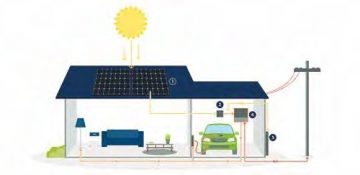
Solar panels help power your home – and your EV.
Getting a correctly sized solar and battery system is critical. It does need to be tailor-made for your house, your EV, and your electricity use patterns. A domestic battery helps you get more out of your solar installation by enabling your EV to be charged when it’s convenient to you, rather than just when the sun is shining.
Charging technology is only getting smarter
Some retailers are already offering off-peak rates for charging EVs overnight. This is just the start of all sorts of new developments that are set to unlock further potential to benefit from your EV.
Vehicle to grid chargers are available overseas that turn your EV into a mobile battery capable of powering your home. Think about it like having an extra battery available for your solar panels and the equation for maximising your investment gets even more interesting.
Already the battery capacity in a Gen 230kWh Nissan Leaf is capable of powering your home for about 10 hours.
Not going in to work one day or staying in on the weekends? You could suddenly have enough power to work from home for the day just by leaving your car plugged in.
Or, your local network company could offer you preferential rates for charging your EV in exchange for giving them the ability to dynamically integrate your car’s spare battery capacity with the local grid, via smart two-way chargers.
As battery capacity increases and more EV models become available in New Zealand, the options for integrating residential solar and battery systems with EVs are only going to increase.
Dollars and sense
Aside from the investment maximisation that’s possible at an individual level, it’s also about managing the transition to a world where EVs are common place and our national electricity generation is providing the extra power needed through low-carbon sources, in addition to the mainstays of hydro, wind and geo-thermal.
Every slow charger (7kW) for an EV adds the equivalent of 2.8 houses to the grid, while every fast charger (22kW) adds nearly nine houses.
As the number of chargers in New Zealand grows, this is going to mean adding whole suburbs’ worth of capacity to the local electricity network. Over time we’ll all pay for the network upgrade to cope with the increased charging load.
Adding a solar and battery system means you’re reducing the need for that network upgrade because you’re helping supply the extra electricity needed right from your rooftop.



Join the conversation