
Rapid-charge lithium sulphur battery technology for EVs and electric aircraft
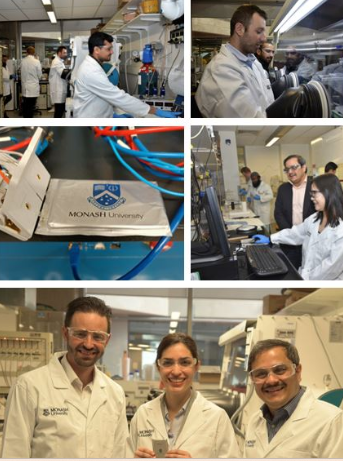
Australia’s Monash University engineers have developed an ultra-fast charging lithium sulphur (Li-S) battery capable of powering long-haul electric aircraft and EVs, along with commercial drones.
Start-up Ghove Energy is working towards manufacturing and commercial applications of the lightweight LI-S batteries, raising pre-seed funding and inviting investors to join.
Researchers aim to demonstrate the technology in commercial drones and electric vertical take-off and landing vehicles (eVTOL) within a year, says Monash, adding the Li-S batteries could power an extra 1000km on a single charge in an EV while cutting recharging time to a few hours.
The breakthrough technology introduces a catalyst inspired by betadine, a common household antiseptic, to accelerate the charge and discharge rates of Li-S batteries which double the energy density of conventional lithium-ion batteries while being significantly lighter and more affordable, the university says.
“With further development, the technology could become a viable option for powering electric aircraft in the future.”
The breakthrough research, a decade in the making and published in Advanced Energy Materials sets a new benchmark for practical lithium sulphur prototypes, says Monash.
“Inspired by the chemistry of betadine, we found a way to accelerate the charge and discharge rates, making them a viable battery option for real-world heavy-duty use,” says Maleesha Nishshanke, a PhD candidate at the Monash Nanoscale Science and Engineering Lab (NSEL).
“Imagine an electric vehicle that can travel from Melbourne to Sydney on a single charge or a smartphone that charges in minutes — we’re on the cusp of making this a reality,” says co-lead author of the paper Dr Petar Jovanović.
Co-lead researcher and ARC Research Hub for Advanced Manufacturing with 2D Materials director professor Mainak Majumder says Li-S technology typically struggled to maintain high performance without degrading quickly but this battery could handle a lot of power being taken out at once without breaking down, while cheaper and storing more energy.
“We’ve leveraged sulphur’s unique chemistry to make a battery that’s both safer and more efficient,” he says.
“With our new catalyst we’ve overcome one of the last remaining barriers to commercialisation – charging speed.
“Our catalyst has significantly enhanced the C-rate performance of Li-S batteries, demonstrated in early proof-of-concept prototype cells. With commercial scaling and larger cell production, this technology could deliver energy densities up to 400Wh/kg,” Majumder says.
“This makes it well-suited for applications requiring dynamic performance, such as aviation, where batteries must handle high C-rates during take-off and efficiently switch to low C-rates during cruising.”
With the global lithium sulphur battery market expected to be worth US$209 million by 2028, Majumder says Monash’s pioneering work could place Australia at the forefront of a rapidly expanding industry.
The research team is refining new additives that could speed up charging and discharging times even more, along with methods that reduce the amount of lithium needed.
Majumder says the research is supported by the US Air Force Office of Sponsored Research.



Join the conversation