
Renault’s bidirectional charger deployed by 2030
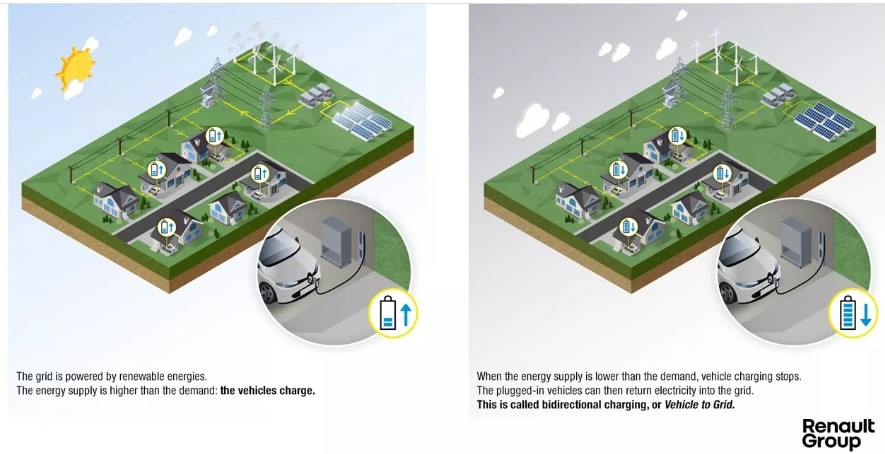
Renault Group and research organisation CEA have jointly developed over three years a new electronic power converter architecture directly integrated into the vehicle’s charger, the group adding it will reduce energy losses by 30%, improve the vehicle’s recharging time and guarantee the battery’s durability.
Its bidirectional nature means it can also store energy from the electricity network, Renault saying it will be deployed on its EVs by the end of this decade.
The new architecture based on wide band-gap semiconductor materials (such as gallium nitride and silicon carbide) makes it possible to reduce energy losses by 30% during conversion, and to reduce heating by the same amount, making it easier to cool the conversion system, the group explains.
In addition, the engineers’ work to optimise the active (semiconductors) and passive (capacitors and wound inductive components) components has enabled a reduction in the volume and cost of the charger. Thanks to the use of ferrite materials, dedicated to high frequency, and a shaping injection process called “Power Injection Molding”, the converter has become more compact, it adds.
This new converter architecture offers a charging capacity of up to 22kW in three-phase mode, allowing for faster charging of the vehicle while ensuring battery durability, says the group.
“This project with the CEA has exceeded our expectations by confirming the ability to achieve the expected performance in terms of efficiency and compactness,” says Renault Group advanced engineering vice president Jean-François Salessy.
“It opens up strong prospects for power electronics, which is a real challenge in the electric vehicle, in order to make the best use of the batteries’ capacities. With bidirectional charging, the vehicle serves the electrical network and enables the end consumer to reduce energy costs.”
The use of innovative materials with joint Renault Group-CEA patents on the charger made it possible to manufacture the dedicated transformer, which is a key component in this type of development, as it allows for a reduction in volume with performance that goes beyond the state of the art, says CEA-Leti chief executive François Legalland.


Join the conversation