
Seal of Approval?

For the Chinese brands working to enter global markets, doing cheap is arguably easy. People will forgive a lot when they are paying much less than for the traditional brands.
BYD seems to be taking another tack. The Atto 3 may have been a strong value leader – while not the cheapest in its segment – while the Dolphin is arguably the premium option in the small electric hatchback market.
With its new Seal, BYD is clearly showing its premium-brand intentions, pitching itself against the Tesla Model 3, but making an argument for consideration against some more traditional premium rivals as well, at a price that – despite being more expensive here than across the Tasman – immediately paints it as the better option on dollars and cents alone.
You can get a Seal in Dynamic form for $62,990 with a 61kWh battery and rear-wheel drive, step up to the Premium with an 83kWh battery and 570km of range for $72,990, or go all out for the Performance, with the big battery and dual-motor all-wheel drive for $83,990.
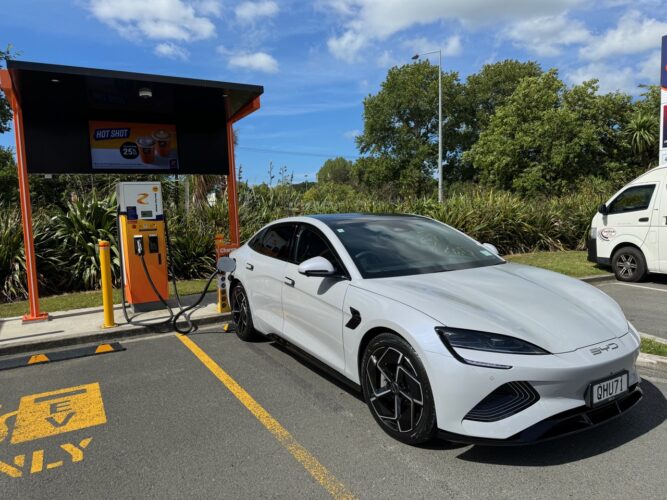
Now, while it is hard to pin down what a Tesla Performance costs at the moment – they have not announced details for what the Highland will be – that is some $13,000 less than the last price for the American model.
We should also note the Seal is over 10cm longer. This is a bigger car, and it shows.
Now, if we look at the party piece of any high-performance EV, the 0-100km time, the Tesla outguns the Seal on the face of it by 0.5 of a second.
But the BYD’s measurement is from a standing start, and the Tesla from a ‘one-foot rollout.’ That means the gap is likely a smidge closer.
It doesn’t matter anyway, as both are brutally quick and neither are the cheapest to perform in such a way – hat tip to the MG4 X-Power for that.
In fact, compared to those two vehicles, I believe the Seal’s talent is that it is the least sporty of the trio.

Don’t get me wrong, it is a very good handling car, with epic grip from the Continental tyres (bye Batman!), accurate steering, and solid brakes.
But it does it with comfort; those Continentals are ‘only’ 19s compared to the 20 or 21-inch units the design department no doubt wanted to fit, and the chassis exhibits a suppleness neither the Tesla nor the MG can provide.
Even the heated and ventilated seats – with a very welcome easy access function – are both comforting and supportive.
The vehicle also features advanced technology like a heads-up display, Frequency Selective Damping (FSD), and Intelligent Torque Adaptation Control (ITAC), elevating the driving experience.
There is also a full safety suite, adaptive cruise control, and lane-keeping technologies. These work well – a big step up from the Atto.
This is high-performance EV driving, gentleman (or gentlewoman) style!

You can take the family too (if you must) as the back seat space is excellent. Unlike the Tesla, my large frame is comfortable back here with plenty of legroom, and despite the sporty shape of the car, the glass roof makes it feel airy.
Interestingly, BYD throws in a clip-in shade for free, though I feel this may be more useful to our Australian cousins.
The Seal’s interior is dominated by the 15-inch touchscreen, which does rotate, but it’s pointless for many as when in Apple CarPlay mode it defaults to landscape.
There is a smaller screen in front of the driver for key information.
The Android-based system works okay and is responsive, but I feel like BYD needs to do a little better on this front – it is just a bit unrefined.
Karaoke – watch our review video out soon – and I would likely prefer an overall cleaner system.

It does have a drive cam, and you can control the car from the app, but both have slightly limited and clunky functionality compared to the American and European competition – although they are light-years ahead of the Korean and Japanese options.
The audio system sounds good but is a bit quiet. We have been told this will be updated.
In-cabin storage is okay. There is a cubby under the transmission shifter and a storage bin under the armrest, while the door pockets are long but a bit narrow.
There is a frunk! It is compact but enough to hold charging equipment and a few small items. The boot is 400 liters and the lid electric, but it is a relatively narrow entrance.
We should talk about the ‘Blade’ battery – BYD’s ace card, that you can punish pretty heavily before it will take a hit – physically as well as from a charging standpoint.

It is the first BYD the first to implement Cell-to-Body technology, integrating the Blade Battery into the vehicle’s structure, enhancing safety.
If I have a concern, it is that BYD is perhaps being a little protective of charging speeds, with the Performance topping out at 150kW on DC, and 11kW on AC.
I think to be competitive it needs to be 200kW, though some would argue that is asking a bit much.
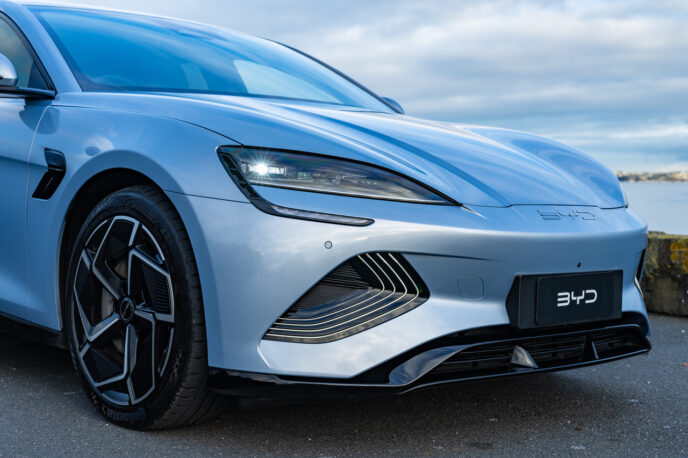
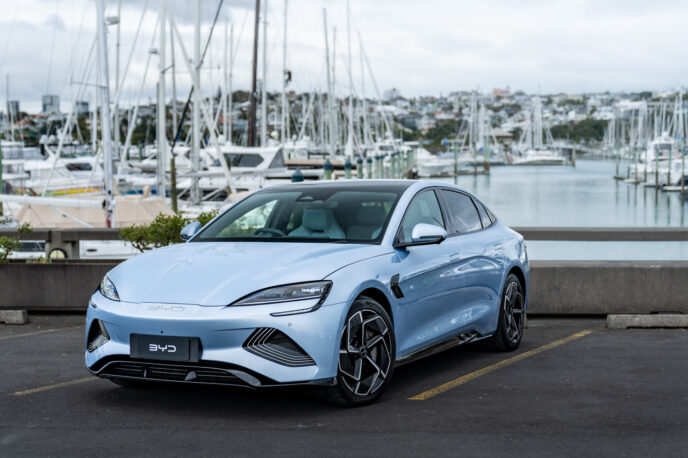
Finally, let’s talk about design. Yes, this car does look a tiny smidge like a Porsche Taycan from the outside. It is in the headlights, and it is no bad thing.
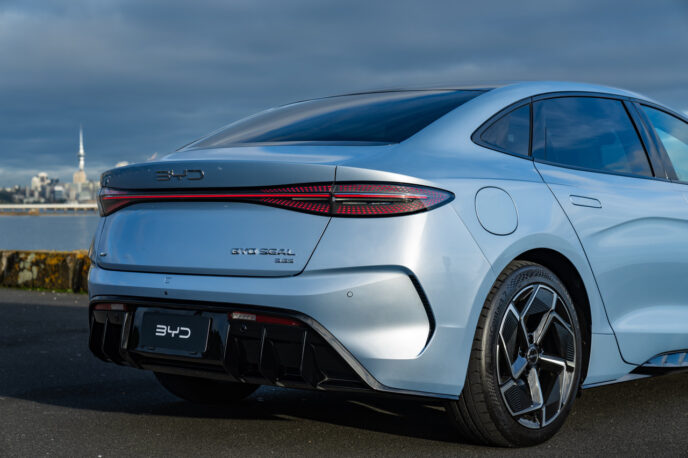
BYD has done enough with the nose and detail work to make the Seal distinctive, I think. Its shape is long and curved, while the rear tucks in neatly.
The rear light bar that runs across the car in a smokey tone looks excellent, though the rear diffuser does look just a little over the top.
It is not tow-rated yet, though there is a cut-through for the fitment of one.
Our Summary
When compared to its competitors, like the Tesla Model 3 Performance, the BYD Seal Performance offers more space and comfort, leaning more towards a GT than a strict sports car.
Its build quality is solid, and the driving experience is both quick and comfortable. However, the infotainment system and technology might be its only slight letdown.
While it will mostly be directly compared to the aforementioned car, I think it has a broader remit.
Bigger cars like the Mustang Mach-E are also no doubt in its headlights, while I think it naturally lines up against the BMW i4.
Yes, I approve of the Seal.



Join the conversation