
SWANS project studies ship collision avoidance
A group of United Kingdom firms has begun a research project to investigate how that would work, Marine Electronics and Communications reports
BMT has teamed with ASV Global and Deimosco Space UK for the Shared Waterspace Autonomous Navigation by Satellite (SWANS) project.
Innovate UK has provided funding for the study into how autonomous surface vessels (ASVs) can use existing and future satellite capabilities for collision avoidance and communications.
 It’s especially focussed on autonomous vessels operating beyond the shore horizon and in congested maritime traffic, BMT managing director Phil Thompson says. The few autonomous vessels already developed use the global automatic identification system (AIS) for collision avoidance.
“But they remain at risk of colliding with vessels or objects not using AIS,” he says.
Others rely upon waterspace management and the actions of other water users to avoid collisions. “Neither of which go far enough in reducing the risk of a collision occurring,” Thompson says.
He says the project would be “critical in helping us to overcome this barrier by developing the first-ever commercially ready, safe over the horizon operating system for congested waterspaces”.
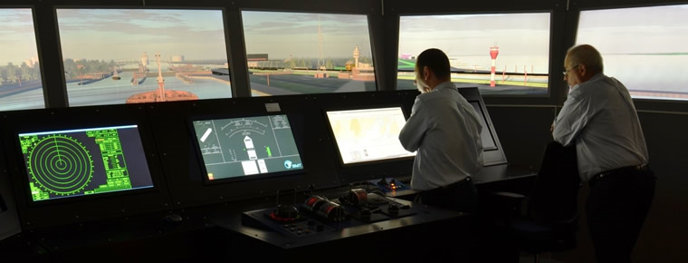
BMT’s Rembrandt ship manoeuvring simulator will be used in the project.
ASV Global will bring its experience holding operations with unmanned vessels out of sight of land using an advanced autonomous navigation system.
Its sales and marketing director Vince Dobbin says the project “has the potential to open up a multitude of applications for the operation of ASVs in busy waterspaces”.
Main objectives include exploiting satellite sensing technology, enabling the delivery of a higher fidelity world model for vessel operators and supervisors, and simulating new scenarios for ASV operations.

Join the conversation