
Teaching driverless cars how to reduce motion sickness
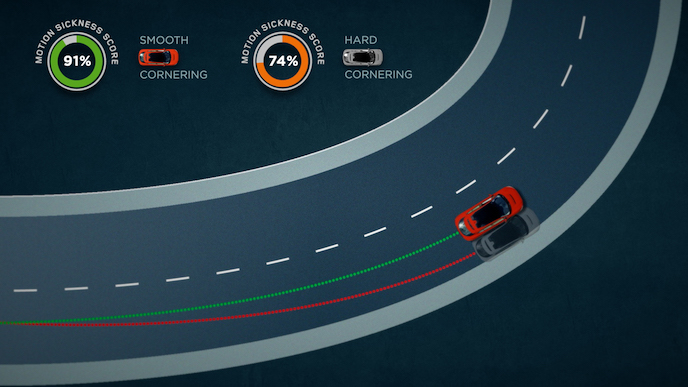
Jaguar Land Rover says it is pioneering software that will reduce motion sickness by adapting the driving style of future autonomous vehicles.
During the first phase of the project, a personalised ‘wellness score’ was developed which could reduce the impact of motion sickness by up to 60%.
Experts at Jaguar Land Rover’s specialist software engineering facility in Shannon have now implemented that score into self-driving software.
The intelligent software combines 20,000 real-world and virtually-simulated test miles to calculate a set of parameters for driving dynamics to be rated against. Advanced machine learning then ensures the car can optimise its driving style based on data gathered from every mile driven by the autonomous fleet.
This technology can then be used to teach each Jaguar and Land Rover vehicle how to drive autonomously, while maintaining the individual characteristics of each model. All helping Jaguar Land Rover’s continued development of the ultimate cabin experience in an autonomous, electric and connected future.
Motion sickness, which affects more than 70% of people, is often caused when the eyes observe information different from that sensed by the inner ear, skin or body – commonly when reading on long journeys in a vehicle.
Using the new system, acceleration, braking and lane positioning – all contributory factors to motion sickness – can be optimised to avoid inducing nausea in passengers.
Engineers are now able to develop more refined advanced driver-assistance systems (ADAS) features on future Jaguar and Land Rover models, such as adaptive cruise control and lane monitoring systems.
“Solving the problem of motion sickness in driverless cars is the key to unlocking the huge potential of this technology for passengers, who will be able to use the travelling time for reading, working or relaxing,” Jaguar Land Rover chief medical officer Dr Steve Iley says.
He says in a post COVID-19 world, where a ‘new normal’ is emerging, customer expectations of private transport are changing, and the focus will be on safe, clean mobility where personal space and hygiene will carry a premium.
New technologies and materials are being developed to meet these expectations at Jaguar Land Rover with today’s vehicles designed to help improve passenger wellbeing, including a driver condition monitor and antimicrobial wireless device charging.
In addition, features such as cooling seats, ambient lighting and multiple seat configurations are proven to significantly reduce the likelihood of motion sickness.
Jaguar and Land Rover models offer adaptive dynamics across its range of vehicles which help to remove low frequency motion from the road, which can lead to nausea.
By altering the ride settings every 10 milliseconds, this ensures passengers always experience high levels of comfort, while also maintaining the dynamic performance of every Jaguar and Land Rover model.


Join the conversation