
The better Tesla?

This story first appeared in the August issue of EVTalk – CLICK HERE to download the magazine FREE
Think Tesla and the Model S and now the Model 3 are what spring immediately to mind. And so they should.
The Model S was the start of the brand’s volume ambitions – the Roadster was very niche – and the Model 3 is the future.
But check the sales statistics for the New Zealand market and it is the Model X SUV that buyers seem to want.
Thanks to imports, there might be more Model Ss on the road but since the arrival of the brand officially, the Model X has been the more popular of the pair.
That should not be surprising, with SUVs dominating all vehicle sales in New Zealand.
And the X also offers more space and convenience over a Model S for a modest price difference – around $15,000 between the S 75 and the all-wheel drive X 75D and less than $9000 more than an S 75D.
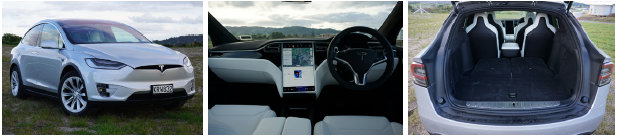
The 75D is the model we got a chance to drive for a weekend recently.
With a base price of $128,900 it compares favourably with Audi’s Q7 range – being $13,000 more than a standard model and $30,000 less than the e-tron plug-in version.
That’s before you start ticking the option lists. Add metallic paint, a white leather interior package, enhanced Autopilot, a “premium upgrades package”, premium audio, six-seat interior package and a tow package and your invoice will hit $176,832. That’s just a few thousand less than an SQ7.
There is no point spending too much time on the standard equipment in a Tesla. Suffice to say they’re loaded: climate control air-conditioning, electric windows, electric tailgate, parking sensors front and rear, reversing camera, that giant LCD screen… The dashboard and major controls are all much the same, if not the same, as in the Model S.
As with the Model S, a key interior feature of the X is a massive 17-inch touchscreen. It controls everything you can think of – suspension, steering, charging, drive modes, climate control, security system.
It also features a Google Maps-based navigation system, using a live data connection that facilitates live updates. Music from Spotify, Pandora and other services can be searched for and played using the screen, the steering wheel or your voice – the car has one of the best voice control systems we have experienced.
Ahead of the driver, traditional instruments are replaced by another screen that features speed, power, Autopilot information, range and consumption details. Systems from the 17-inch screen can be overlaid there as well.
Sitting in the Model X is unlike any other car in the market. Front seat passengers are treated to an open, airy experience, thanks to the huge panoramic windscreen.
The top half is tinted to protect you from the sun and a surprisingly effective set of sun shields folds across the middle.
The centre console is huge and has multiple cupholders and storage bays.
The front doors are automatic – touch them and they pop open; pull the handle or push the brake pedal if you’re the driver and they close smoothly on their own.
Rear passengers access through the much-lauded but not yet perfect Falcon wing doors. Push the exterior handles and they open up, changing their course to avoid objects in the way.
In our standard-height garage, they would not open fully although they positioned themselves in a way that access was still easy.
One issue we discovered was if you stood too close to the door – as people often do when waiting to enter a car – the doors noticed your proximity and stopped moving too early.
When hanging partially down, they can also block access for front seat passengers walking away from the vehicle. But neither issue is significant – the doors are still a stunning party trick.
You can option the X with five, six or seven seats. Ours was a six-seater, with two “captain’s chairs” in the middle row. Although smaller than the front seats, these middle row pews are very comfortable and legroom is excellent – they slide fore and aft for extra legroom.
The third row is a little tighter but still comfortable enough for small adults.
The X’s boot space is not bad compared to other large SUVs. On initial inspection the rear area is small but it hides a large storage space underneath that others lack. No one else has a “frunk” either, which has enough space for a small family shopping trip.
With the third row folded down, there is a ton of space, enough for four to five large suitcases.
At 2300kg, more than 200kg heavier than an S 75D, and with a higher ride height, the X is not as sharp to drive as a Model S.
It is probably not as sporty to drive as the large German SUVs but it is still excellent. It feels pleasantly planted and the grip is excellent. The ride is soft and comfortable, less harsh than the S.
Like the S, the steering is not very engaging but that seems to suit the X better. We like the brakes, which feel less wooden and more natural than most electric vehicles.
This was our first chance to try Autopilot and we were impressed – though it is not yet perfect.
On a motorway or well-marked highway, it does a fantastic job of keeping within the lane and matching the vehicle in front. Seeing what it sees through an animation on the dashboard is a great feature.
It struggles in two areas – at times it can search for the edge of the lane, drifting from left to right and it also has trouble with the end of merging lanes, either giving up entirely or heading one way or another in search of a line to guide it.
Volvo’s ProPilot system is smoother in both of those areas although Tesla’s system is better overall for “hands-off” driving and has more hardware to make the most of the future development.
Want to tow? The Model X can pull up to 2280kg on its standard 20-inch alloy wheels.
We put the X through a tough test straight out of the gate. Rolling out of the Tesla pop-up store in Ponsonby, we pointed its nose north, heading for an engagement in Whangarei.
Tesla calculates up to a 417km range under the EU system for the car and we would attempt to do around 250km. Need more range? The 100D claims it will go 565km.
We suspect that driving without significant care for efficiency will yield you a real-world range of 325km-350km per charge. With fast-charging that puts most of the populated parts of the country in range.
But attempting a long distance in the Model X threw up an issue we did not face in our shorter run in the Model S. Fast-charging is a beautiful thing and with smaller electric cars like our Leaf, filling to 90% in under half an hour is great.
Plug into a 50kW fast charger in a Tesla and you are looking at closer to 90 minutes to do the same thing. Tesla is resolving this by putting out its 120kW Supercharger network – but so far there is only one (in Hamilton).
So, for now, you will need to keep time required in mind when using ChargeNet or other stations that have far better geographic coverage.
We loved the Model X. It is the better Tesla – for now – and most Kiwi buyers will find it suits their needs and our conditions better than a Model S. And it is not that much more expensive.
The biggest negative of our time with the car? Don’t order the white seats, people. They look great but you will be constantly terrified of marking them.

Join the conversation