
Two Auckland e-ferries in 2024

Two electric ferries capable of carrying 200 people each will be in service on Auckland’s Waitemata Harbour in 2024.
Auckland Transport will operate the two electric fast ferries across all major inner and mid-harbour services, and the new ferries will provide a pathway for further ferry electrification in the future, says energy and resources minister Dr Megan Woods in launching the project at Auckland’s downtown ferry terminal.
Ferries contribute about 20% of Auckland’s public transport emissions, while these electric ferries promise to dramatically reduce greenhouse gas emissions, with each electric ferry displacing about 1000 tonnes of carbon emissions annually, she explains.
“This project will be a major boost to the rapidly developing maritime clean technology sector in New Zealand and will further upskill the maritime transport sector in New Zealand.
“This is a boost for our climate goals and our economy, which is especially vital as we continue our economic recovery from COVID-19.”
Woods says the Government is committed to supporting low-emission transport options.
“We’ve invested significantly in on-road electric vehicles and have pledged to decarbonise the public transport bus fleet.
“Electrifying water transport is a natural next step in making public transport cleaner.”
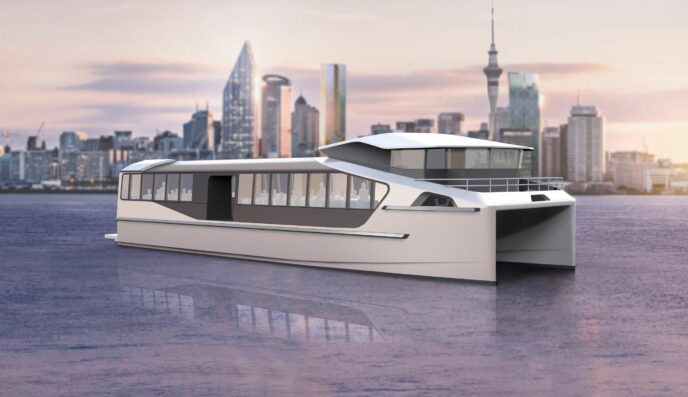
Woods says she’s keen to board an Auckland electric ferry once they are launched.
The project is a collaboration between the Government, Auckland Transport, EV Maritime and boat builders McMullen & Wing.
Auckland Transport receives a $27 million grant from the Government’s Infrastructure Reference Group’s COVID-19 Response and Recovery Fund to pay about 75% of the costs of constructing the two new electric ferries, made of light-weight carbon fibre and using Kiwi technology such as Hamilton Jet’s propulsion and control systems.
On-wharf chargers which Auckland Transport will fund, and is currently working with Vector on, will power up the electric ferries.
The ferries will have a 25knot top speed (on par with today’s diesel ferries) and about 40km range – a significant increase in capability from existing electric ferries around the world.
EV Maritime co-founder Michael Eaglen emphasises the importance of this capability for enabling electrification of commuter ferry services, where it is the higher speed, longer range services that represent the lion’s share of emissions.
“In Auckland, short-distance low speed routes like Devonport and Bayswater represent about half of annual sailings but less than 10% of ferry emissions,” he explains.
“These short trips are relatively easy to electrify, but to make a real impact on our emissions, which we must, it’s important to address the other half of the services – the longer, faster, mid-harbour and outer-harbour routes which are responsible for over 90% of ferry emissions.
“Electrifying these longer services is much harder, because their energy use is so high; but that’s precisely why it’s important.
“We commend the Government and Auckland Transport for having the courage to confront the issue head-on by investing in this project to unlock widespread electrification of the Auckland network.”
Eaglen also acknowledges the role Auckland ferry operator Fullers 360 has played in this process. “Fullers has backed the EV Maritime vision from the outset, encouraging us to take the step of proactively developing these boats, providing valuable input into the development of the design and the operational architecture and generously providing financial support to help us reach this point,” he says.
“We continue to work closely with Fullers, Auckland Transport and others, not only on the implementation of this project but also on the wider decarbonisation of Auckland’s ferry fleet.”


Join the conversation