
Video: Daimler Trucks unveils fuel cell concept and EV strategy
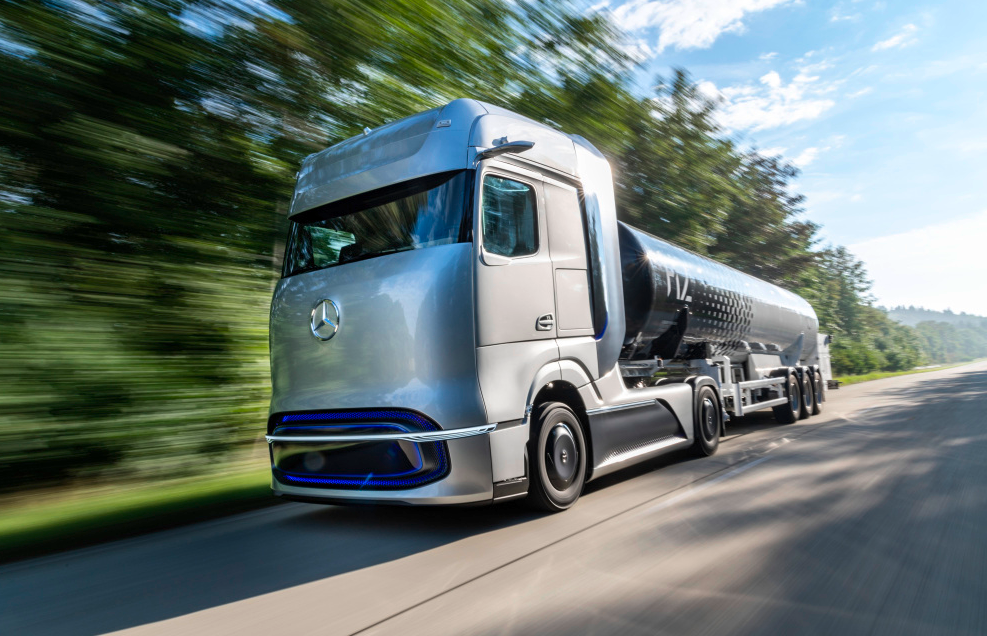
Daimler Trucks has announced its vision for a hydrogen-electric future with the unveiling of its very first Mercedes-Benz fuel cell truck concept and a battery electric long-haul truck with 500km range.
The GenH2 fuel cell vehicle comes with a range of up to 1000km and was among new products revealed in a livestream event from Berlin on September 16.
Customer trials are scheduled to begin in 2023 and series production will start in the second half of this decade, the company says.
The fuel cell truck will complement the Mercedes-Benz eActros LongHaul battery electric truck which was also announced at the event.
This will have a 500km range on a single charge and is projected to be ready for series production in 2024.

The Mercedes-Benz eActros battery electric truck with a range of over 200km is due to go into series production in 2021.
Daimler Truck AG board of management chairman and chief executive Martin Daum says the company is aiming to make “genuine locally CO2-neutral alternatives” for its customers.
“Our customers make rational purchasing decisions and are unwilling to compromise on their trucks’ suitability for everyday use, tonnage and range.
“With our alternative drive concepts from Mercedes-Benz – the GenH2 Truck, the eActros LongHaul and the eActros – and our electric trucks of the Freightliner and Fuso brands, we have a clear focus on customer requirements,” Daum says.

German transport and digital infrastructure Federal Minister Andreas Scheuer says zero-carbon delivery vehicles are needed on the roads and hydrogen fuel cell trucks are part of the solution.
“There is huge potential inherent in hydrogen for the protection of our environment and a strong economy.
“That is why we have been funding hydrogen as a transport fuel for over ten years.
“We will continue to provide strong support to the development of climate-friendly drivetrains and innovations in and for Germany. This will include, but not be limited to, significantly expanding the funding of vehicles,” Scheuer says.
Daimler has already reached a milestone of more than seven million kilometres driven by customers worldwide in its range of battery electric vehicles.

This includes its Mercedes-Benz eCitaro bus, Fuso eCanter light-duty truck and the Mercedes-Benz eActros
and Freightliner eCascadia in the heavy-duty segment.
The company says these vehicles present a strategy for the electrification of urban distribution to international long-haul transport and are part of a commitment to the goals of the Paris Climate Protection Convention.

Daimler Truck and Bus Australia Pacific president and chief executive Daniel Whitehead says the company “is already the go-to choice” for Australian and New Zealand businesses looking to reduce fuel consumption and cut emissions with trucks that employ class-leading safety features.
“The Freightliner Cascadia, Mercedes-Benz Actros and Fuso Shogun all feature Euro 6 or equivalent emission-level engines and we will also introduce the all-electric Fuso eCanter here next year.
Whitehead says the new models previewed in Berlin are “especially exciting” for the Australian and New Zealand market “and point to a very promising future”.
Daimler says it’s pursuing similar vehicle schedules for the North American and Japanese markets as it is for Europe.
It aims to include series-produced vehicles with battery-electric drive in all those regions by 2022.
The company also has the ambition to offer only new vehicles that are CO2-neutral in driving operation “from tank to wheel” in Europe, North America and Japan by 2039.
Its ePowertrain modular platform architecture will be the basis of all its medium- and heavy-duty CO2-neutral, all-electric series-produced trucks for both batteries and hydrogen-based fuel cells.
It says the ePowertrain system will help achieve “synergies and economies of scale” for all relevant vehicles and markets.
Daum says battery electric and hydrogen-based fuel cells have the “potential to succeed in the market in the long term” and now it’s time for key leaders to do their part.
“It is now up to policymakers, other players and society as a whole to provide the right framework conditions.
“To make CO2-neutral all-electric vehicles competitive, regulatory and government action is needed, including the necessary infrastructure for charging with green electricity and for the production, storage and transport of green liquid hydrogen,” Daum says.
Join the conversation