
Video: Roboats in Amsterdam

Self-driving “Roboats” are being deployed in Amsterdam’s canals.
The final project in a self-navigating trilogy to test fully autonomous robotic boats has been achieved by scientists from the Massachusetts Institute of Technology (MIT) Computer Science and Artificial Intelligence Laboratory (CSAIL) and the Senseable City Laboratory, together with the Amsterdam Institute for Advanced Metropolitan Solutions (AMS Institute) in the Netherlands.
“Roboat” started as prototyping small vessels in the MIT pool in late 2015, a two-metre long half scale model released last year.
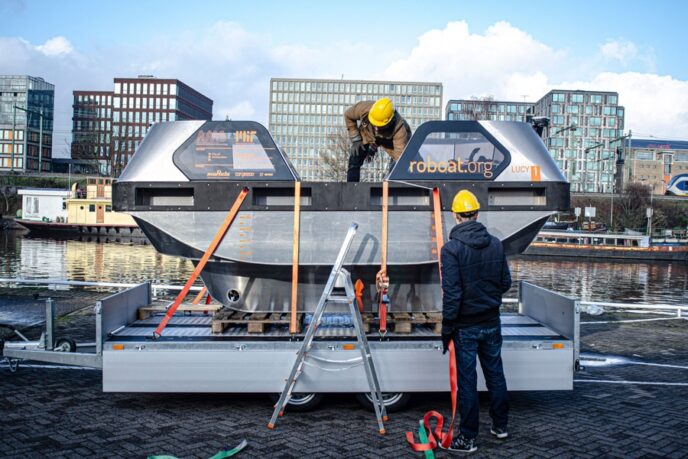
Now, two full-scale Roboats are on the canals, capable of carrying up to five people, collecting waste, delivering goods, and providing on-demand infrastructure.
Two seats face each other, and the AV boats have orange block letters on the sides illustrating the makers’ namesakes.
The fully electric boat with a battery the size of a small chest has up to 10 hours of operation and wireless charging capabilities.
“We now have higher precision and robustness in the perception, navigation, and control systems, including new functions, such as close-proximity approach mode for latching capabilities, and improved dynamic positioning, so the boat can navigate real-world waters,” CSAIL director and MIT electrical engineering and computer science professor Daniela Rus says.
“Roboat’s control system is adaptive to the number of people in the boat.”
To swiftly navigate Amsterdam’s bustling waters, Roboat needs a meticulous fusion of proper navigation, perception, and control software.
Using GPS, the boat autonomously decides on a safe route from A to B, while continuously scanning the environment to avoid collisions with objects, such as bridges, pillars, and other boats.
To autonomously determine a free path and avoid crashing into objects, Roboat uses lidar and a number of cameras to enable a 360-degree view. This bundle of sensors is referred to as the “perception kit” and lets Roboat understand its surroundings.
When an object like a canoe is picked up, the algorithm flags the item as “unknown.” When the team later looks at the collected data from the day, the object is manually selected and can be tagged as “canoe.”
The control algorithms – similar to ones used for self-driving EVs – function like a coxswain giving orders to rowers, by translating a given path into instructions toward the “thrusters,” which are the propellers that help the boat move.
Small cameras on the Roboat guide it to the docking station, or other boats, when they detect specific QR codes.
“The system allows Roboat to connect to other boats, and to the docking station, to form temporary bridges to alleviate traffic, as well as floating stages and squares, which wasn’t possible with the last iteration,” MIT urban studies and planning department professor and Senseable City Lab director Carlo Ratti says.
While regular boats have unique hulls, designed for specific purposes, Roboat has a universal hull design where the base is the same but the top decks can be switched out depending on the use case.
“As Roboat can perform its tasks 24/7, and without a skipper on board, it adds great value for a city,” MIT urban studies and planning department principal research scientist Fabio Duarte says.
“However, for safety reasons it is questionable if reaching level A autonomy is desirable,” he says.
“Just like a bridge keeper, an onshore operator will monitor Roboat remotely from a control centre. One operator can monitor over 50 Roboat units, ensuring smooth operations.”
Roboat is now piloting the technology in the public domain at Amsterdam.

Join the conversation