
Will EV charging stations be needed in the future?
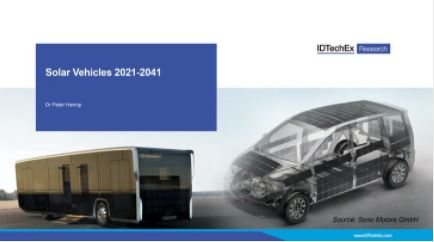
The solar supercapacitor is a ‘dream ticket’ for EVs and may mean never having to use an EV charging station.
So says IDTechEx in its report Solar Vehicles 2021-2041.
Lightyear and Sono Motors cars with solar bodywork achieve range with half the battery and, for the gentle, never suffer a charging point, IDTechEx chairman Dr Peter Harrop says.
“Consequently, solar adds space, reduces fire risk, reduces end-of-life disposal misery. Hyundai is committed. Toyota researches solar making three times the electricity.”
Harrop says that for cars, and for the robot shuttles that will replace them in some cities, supercapacitors will multiply these solar delights, being fast enough to compensate passing shadows, for example.
“Already, they propel factory automatic guided vehicles, are easily charged frequently in seconds, where reliability and fit-and-forget gives payback.”
Harrop says this issue is also covered in the IDTechEx report Supercapacitor Markets, Technology Roadmap, Opportunities 2021-2041
.
The latest supercapacitors escape battery safety and disposal issues. They waste 1% of electricity not 15% for batteries, he adds.
As “AGVs for humans”, robot shuttles trialling in 20 countries have billions of dollars of investment analysed in the IDTechEx report Robot Shuttles and Autonomous Buses 2020-2040.
Symmetrical, so no U-turns, gated to go relatively slowly, space-efficient, they will enter malls, cross piazzas, use paths because they safely empower the disabled and the young, Harrop says.
“Shuttles are not yet viable with supercapacitors despite deep discharge meaning less kWh needed, somewhat offsetting their larger size, and despite effectively infinite cycle life,” he says.
“Three steps get there – robotic fast charging like AGVs, solar bodywork meaning even less energy storage, and the newly-selling 100Wh/kg supercapacitors – up 10 times.
“Enjoy trouble-free, 30-year robot shuttles, city cars, city buses with rock bottom cost of ownership?”
Harrop says contrast that with most electric cars.
“They sell on up-front-price and range but consider the experimental French supercapacitor-dominant shuttle that also has a battery.
“Appraise the many supercapacitor researchers demonstrating even greater Wh/kg in the IDTechEx report Supercapacitor Materials and Formats 2020-2040. There is a roadmap here,” Harrop explains.
“Meanwhile, companies such as Lightyear selling solar bodywork capability could usefully offer leverage with supercapacitors long before the demonstrated supercapacitor car bodies become commercial and later integrated with solar bodywork.”
Join the conversation