
Video: EV charging via wireless under study
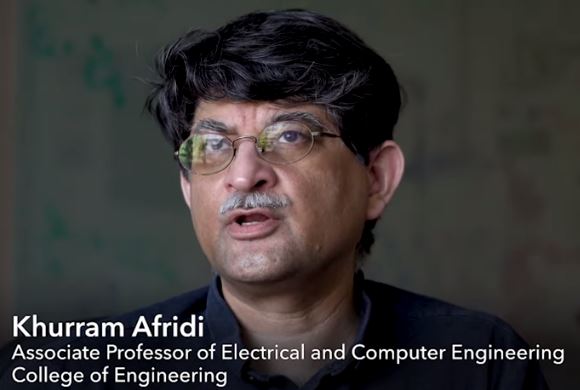
EV drivers may in future just change lanes and drive over charging strips in the road to recharge their EVs.
Khurram Afridi, an associate professor of electrical and computer engineering in the College of Engineering at Cornell University in New York, is working on just such a method for repowering EVs, autonomous forklifts and other mobile machines – while they continue to move.
It would save time and improve productivity, while paving the way for more sustainable e-mobility, the campus newsletter the Cornell Chronicle reports.
Wireless charging has proven difficult and expensive to commercialise for road charging, but Afridi’s team is using high-frequency electronics and high-power electronics to create a new field and enable new applications.
“Wireless power transfer is based on the same underlying physics used to send messages through radio waves to spacecraft in deep space, things like Voyager,” Afridi says. “Except now we are sending much more energy across much shorter distances, to moving vehicles.”
Two insulated metal plates on the ground, connected to a power line through a matching network and a high-frequency inverter, create oscillating electric fields that attract and repel charges in a pair of matching metal plates attached underneath an EV.
This drives a high-frequency current through a circuit on the vehicle, which rectifies it and the rectified current then charges the battery.
Afridi’s team boosts the voltage and operate the system at very high frequencies to achieve large levels of power transfer.
He says it’s about 200 times faster than the latest magnetic field systems developed for EVs.
The team’s system is expected to be smaller, lighter, less expensive and easier to embed.
The wireless charging technology harnesses the power of electric fields, but boosts the voltage and operates at high frequencies to achieve large levels of power transfer.
Afridi’s team has partnered with others to develop charging plates based on engineered metamaterials to better focus their electric fields.
Its biggest innovation is the active variable reactance (AVR) rectifier, which allows a vehicle to get full power when passing over the charging plates even if the plate pairs– laid out every few metres – are not fully aligned.
The AVR also helps deliver power to larger vehicles like trucks that have increased clearance between their undercarriages and the ground.
Afridi believes electrifying high-traffic roadways should come first, especially to support large, long-haul trucks.
Another option is to focus on cities, installing charging strips at stop signs and traffic lights, so drivers recharge while they wait.
Autonomous robots could work around the clock in factories and warehouses using the same technology.
Afridi is working with Toyota Material Handling North America to develop in-motion charging for forklifts and material-handling mobile robots.
He is also part of a National Science Foundation-funded international research centre that advances sustainable, electrified transportation.

Join the conversation