
Urgent need for new stationary storage
Starved of lithium-ion batteries and pumped storage sites, the stationary energy storage business is urgently looking for alternatives.
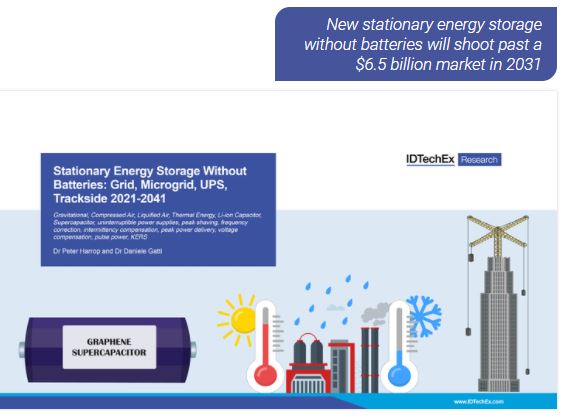
That’s according to the new IDTechEx report, Stationary Energy Storage Without Batteries: Grid, Microgrid, UPS, Trackside 2021-2041.
“Tesla now sells its Powerwall house battery only to those buying the full solar house and, like its competitors, it has delayed electric vehicle launches also due to battery shortage,” IDTechEx says.
“Metals shortages are taking over from too few gigafactories as the primary impediment ongoing.”
Demand for EVs and grid renewables storage is rocketing even before solar houses reach the tipping point and need tens of millions more, IDTechEx adds.
“In addition, energy-independent smart cities need distributed energy storage for their ocean, wind, and ubiquitous solar power.”
IDTechEx says self-leakage makes lithium-ion batteries useless for the new requirement of six-month storage season-to-season arising from all that cheap solar.
“Pumped storage cannot do it because it is busy with shorter-term needs.”
Alternative batteries are gaining traction and IDTechEx has a new report Redox Flow Batteries 2021-2031 which clarifies how they are succeeding, but more is needed.
Gravitational, compressed air, liquified air, thermal energy, li-ion capacitor and supercapacitor stationary energy storage and other options are scoped in the stationary energy report.
They’re used in uninterruptible power supplies, peak shaving, frequency correction, intermittency compensation, peak power delivery, voltage compensation, and pulse power.
“Add stationary kinetic energy recovery systems KERS, notably trackside tram and electric train recovery integrated with pulse starting, with pick-and-mix options for each application.”
IDTechEX says the same is true of distributed energy storage compared to massive grid storage both short-term and seasonal.
“Battery-less stationary storage will surge to a US$6.5 billion business in 2031 with much more beyond,” IDTechEx chief executive Raghu Das says.
Das says: “For electricity supply, see how there is scope for storing hydrogen for fuel cells, using flywheels, new lithium-ion supercapacitors, pseudocapacitors, thermal storage, liquifying or compressing air and so on.
“These non-battery solutions mostly involve no precious metals, toxins or explosions and the research pipeline of improvement is formidable,” he explains.
“Many non-battery options are promised to reach half the levelised cost of storage of lithium-ion batteries. We determine which ones are believable.
“Electric train systems save 15% of their energy bill if 95% efficient supercapacitors grab train braking energy then surge it into trains leaving. Not batteries.”



Join the conversation