
EV fires an opportunity for material suppliers
General Motor’s first recall of the Bolt in 2020 was a significant milestone in the EV industry.
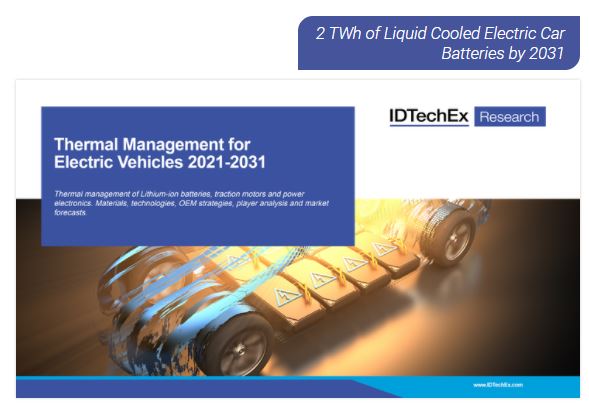
About 69,000 cars produced between 2017-2019 were recalled for potential battery fires, says IDTechEx in its report Thermal Management for Electric Vehicles 2021-2031.
The “solution” was a software update limiting the battery capacity to 90% and an inspection of the battery.
In 2021, two more Bolts caught fire, both of which had the recall.
Continued investigation between GM and LG Chem has determined the cause is the “presence of two rare manufacturing defects in the same cell”. This has prompted another recall by GM to replace the battery modules – the recall said to cost GM around US$11,000 per vehicle, totalling nearly US$800 million.
GM isn’t the only one feeling the heat.
Hyundai revised its operating profits after recalling around 82,000 EVs (mostly Konas but also Ioniqs and Elec City buses) due to battery fire risks, IDTechEx says.
The total cost of this recall was estimated at US$900 million with LG Chem taking the majority of these costs.
Ford’s Kuga plug-in hybrid also faced issues with cells supplied by Samsung, resulting in a recall of 33,000 cars costing Ford about US$400 million.
While OEMs and governments are setting out bold electrification targets for the automotive industry, these high-profile recalls and fires do little to instil confidence for potential consumers making the shift to EVs, IDTechEx believes.
Analysis from various sources such as Pinfa (Phosphorous, Inorganic and Nitrogen Flame Retardants Association) actually shows that fires in EVs are less common than those in traditional internal combustion engine (ICE) vehicles.
IDTechEx’s report addresses several aspects around the thermal design of EVs including fire occurrence, detection, and prevention.
The key issue is that EV fires tend to be much more severe and attract a lot more press, it says.
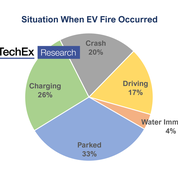
A Hyundai Kona fire in 2020 blew the roof off the garage in which it was stored. Equally scary is the scenario in which these fires occur; whilst a fire might be expected after a crash or damage to the battery, a large proportion of EV battery fires occur when the vehicle is parked, not driving or charging, and with no obvious trigger.
IDTechEx research shows that about a third of EV fires occurred in this situation.
While IDTechEx expects EVs to continually improve in safety, it believes there may always be the risk of a battery fire due to many potential causes.
“This presents an opportunity for those material suppliers making thermal interface materials (TIMs), flame-retardant materials, or fire protection materials,” it says.
“TIMs can help with the thermal management of EV batteries making it less likely they will overheat. Fire-retardant construction materials and fire protection materials are beneficial to enclose a fire or prolong the time between a thermal runaway event and the fire exiting the battery pack.”
Regulations are also evolving on this front.
China implemented new EV fire safety regulations at the start of 2021 with various considerations, but one is a five-minute warning between a thermal event and fire or smoke exiting the battery pack.
The EU also has various draft regulations with a similar focus.
IDTechEx expects regulations in this field to become more stringent, presenting greater opportunities for material suppliers.
Pack-level fire protection solutions in the EV industry to date include ceramic blankets, aerogels, and fire-resistant coatings, all of which have benefits and trade-offs between melting temperature, thickness, weight, and cost.
Additionally, there is a whole portfolio of fire-retardant polymers used within EV battery packs including silicones, polycarbonates, polyimides, polyesters, and more.
The sheer variety of applicable materials and the growing, potentially huge, EV market represents a major target for many players along the supply chain for EV materials, from raw ingredient suppliers to material formulators and suppliers.



Join the conversation