
And the winner is … EVtalk EV of the Year awards
This story first appeared in the January issue of EVtalk – CLICK HERE to download the magazine FREE
While it would be nice to be the first to hand one over, electric vehicles are no strangers to awards in New Zealand.
In 2015 the BMW took out the New Zealand Car of the Year, and since then battery electrics and plug-in hybrids have begun to collect a solid collection of silverware.
The team behind EVtalk decided we would throw our opinion into the mix as well.
We’ve managed to get our hands on pretty much all of the electric cars launched in New Zealand over the last year, and a few imports that have yet to receive an official arrival.
And all the arrivals – and a few of the existing cars that were already here and received updates were impressive.
New Zealand is finally beginning to get a reasonable range of electric vehicles, though 2019 should be even better.
There will be new offerings from Audi, Jaguar, Nissan and more.
2020 is likely to feature even more new models.
So which cars did we pick as the best of 2018?
EVtalk Electric Vehicle of the Year
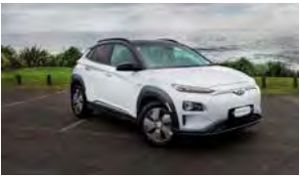
Winner: Hyundai Kona EV
Hyundai New Zealand has put much effort to get electric vehicles into the hands of New Zealand drivers, particularly the hands of influential fleet customers.

The Ioniq is priced and has a range that makes it well suited to being a pool car, and has sold in solid numbers.
While it is arguable that they need it, most consumers want more range.
Buyers also love SUVs, and Hyundai combined both of these things into the Hyundai Kona.
While it may not be an entirely complete comparison, we like to break down electric car pricing to kWh of battery capacity, arguably as this also indicates how much range you are getting for your buck.
A used import generation two Leaf runs at under $1000 a kWh.
In the new vehicle market, the numbers are – on the whole – a little higher.
A ZE40 Renault Zoe runs at over $1700 a kWh, a Tesla Model S 75D $1733, a BMW i3 runs at $2200.
Even a parallel imported new-generation Leaf comes in at $1375.
The new Hyundai Kona Electric with a 64kWh battery resets the bar at $1125.
“Does that mean it is not expensive, and that $73,990 – or $79,990 for the Elite model Hyundai let EVtalk test for a week – is a fair price for a small SUV without all-wheel drive?” we said in our review.
“Heck no, but the progress this model makes in bringing down the actual cost for electric vehicle technology is huge.”
The Kona has quickly become the top-selling electric vehicle in the country and is likely to stay there for some time.
Honourable mentions:Tesla Model X – The X is not really in the running this year as it was not launched or significantly updated, but we drove it a lot and fell in love with the huge beast.
It is comfortable, performs like it shouldn’t and is a great road trip wagon.
BMW i3 – We gave the base model version with the new 94Ah battery a go.
This plastic-fantastic is still futuristic and charming to drive, and BMW’s habit of continually upgrading battery size and range without lifting the price should be lauded.
EVtalk Plug-in Hybrid of the Year
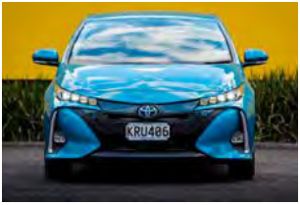
Winner: Prius Prime
While purists may not be happy, plug-in hybrids continue to play the key role of a stepping stone to full electrics – particularly for fleet businesses.
Range anxiety is less of an issue, and with smaller batteries, initial investment is down as well.
Our winner this year is the Toyota Prius Prime.
While the market leader has been selling imported Prius plug-ins for some time, this was its first offering of a new car with a plug.
It launched around the same time as its new drive-away pricing scheme, which helped make it the country’s cheapest new plug-in at $48,490.
An 8.8kW battery gives it a range of around 63km, though our testing would suggest that is a little optimistic.
Official fuel consumption is just 1 litre per 100km – though again that needs to be in ideal conditions.
“All-in-all, a great vehicle for getting around inexpensively.
Honourable mentions:Volvo XC60 T8 – The XC60 is a brilliant vehicle in its own right, and in plug-in form, it has the added element of being able to cruise along in electric-only mode or blast along at sports car pace using the petrol engine as well.
Mitsubishi Outlander PHEV – It may be getting long in the tooth, but slight upgrades, a range boost and a price cut mean this is still a very appealing buy for Kiwi families.
EVtalk Commercial EV of the Year
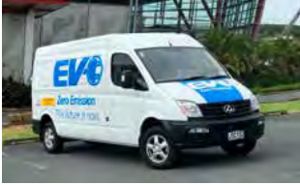
Winner: LDV EV80
If you want to cut the country’s carbon budget, freight and passenger transport are an area that cannot be ignored.
Working vans and trucks spend all day on the road, so replacing one with an electric model can make a big difference.
While Renault was first to market with an electric van here with the Kangoo, the Chinese-made LDV EV80 landed late in 2018 to many preorders.
Both freight and passenger versions have already hit the road, a year or more ahead of when European large-van competitors are likely to arrive.
The model also serves as the base for Tourism Holdings Limited’s electric motorhome project, and an EV80 truck is now working as a maintenance vehicle for the Manapouri Power scheme.
The 10.4 cubic metre cargo van can carry up to the 1000kg payload (down 400kg on the diesel version) – fitting up to three pallets.
LDVs claim the high-efficiency lithium iron phosphate battery can be fully charged in two hours, giving it a 150km to 180km range with about half the maximum payload.
We tested that and agreed it is entirely possible.
“We think the EV80 steers and rides better than the rest of the LDV range.
The electric power steering feels solid and responsive enough for round town work,” we noted in our review.
“LDV has been marketing the EV80 to customers with between 150km and 180km possible, and they are on the money.
A little more caution and I see 200km as an absolute possibility.”
Honourable mentions:Renault Kangoo – It has been around a few years, but the Renault Kangoo has seen a boost in the last 12 months with the arrival of the ZE40 model with a bigger battery and a longer range.
The Renault is basic, but a very clever little van.
Nissan e-NV200 – The import-only Nissan is so popular globally they have become tricky for importers to get their hands on.
They are easy to drive, and while a little short on range this is being solved with the availability of a new 40kWh battery pack.
The EVtalk EV of the Year awards are sponsored by TransNet NZ.

Join the conversation