
Autonomous mobility services could reach US$2.5 trillion in 20 years

Autonomous driving technologies are disrupting business models for the traditional auto industry.
Tech giants like Google and Baidu, as well as mobility service companies such as Uber and Didi, have joined the race with car companies to shape the future mobility system.
Autonomous mobility can become a US$1.4 trillion market by 2040 in terms of car sales, IDTechEx technology analyst Dr Na Jiao says in releasing the new report Autonomous Cars and Robotaxis 2020-2040: Players, Technologies and Market Forecasts.
When considering the additional revenue from autonomous mobility services, the total market value for autonomous cars and robotaxis can reach US$2.5 trillion per year by 2040, the report adds.
The research projects that autonomous driving technologies will accelerate the arrival of peak car sales, in other words the end of mass private-car ownership, in 2031. This points towards a gigantic root-and-branch transformation of the automotive industry in the coming decades.
Shared mobility service companies such as Uber, Lyft and Didi have been disrupting the travel market, but they haven’t really solved problems such as traffic congestion and they have had little impact on private-car ownership, Jiao says.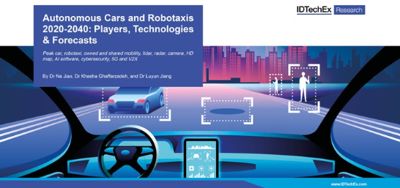
They are still more expensive than owning a private car, therefore they are at most competing with the taxi market.
However, mobility services enabled by autonomous driving technologies, which allow fleet operators to eliminate the biggest operation cost – the human driver – will open a pathway towards a cheaper alternative to purchasing and owning a private car, Jiao adds.
In the next two decades, mobility-as-a-service (MaaS) enabled by autonomous driving technologies will grow rapidly to meet the increasing travel demand and in the meanwhile gradually replace private driving.
The report builds a detailed technology roadmap and a granular market forecast for autonomous mobility.
It segments the market by level of autonomy, by shared and private ownership, and by the value of enabling hardware and software components such as lidar, radar, camera, computing platform, artificial intelligence and software, cybersecurity, 5G and V2X, and so on.
The report finds the transformation towards autonomous mobility will not take place overnight considering not only the technologies, but also the regulatory and public perception barriers.
Moderate and aggressive scenarios are outlined.
Auto OEMs are changing their business models from just car manufacturers to mobility service providers to capture more profits.
Geely, for example, claims that by 2025, a third of all Volvo cars will be autonomous and they will become not only the car manufacturer, but also the mobility service provider.
IDTechEx has also published an analysis of the lidar market, Lidar 2020-2030, available at www.IDTechEx.com/Lidar.

Join the conversation