
Autonomous shuttles taken to the limits
This story first appeared in the August issue of EVTalk – CLICK HERE to download the magazine FREE
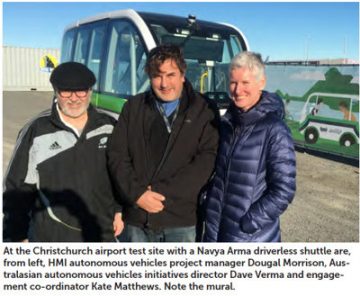 Self-driving shuttles being trialled in Christchurch could be certified roadworthy this month and be on the road within six.
New Zealand company HMI Technologies Ltd (HMI stands for Human Machine Interface) has partnered with Christchurch International Airport to test a Navya Arma.
The French assembled level-4 autonomous EV is among several such vehicles HMI is “testing to destruction” on a secure road next to the airport.
HMI’s autonomous vehicles initiatives director Dave Verma is in charge of the trials programme for New Zealand and Australia. The company has just announced a trial in Sydney and another in the planning stages for La Trobe University in Melbourne.
Verma says HMI is planning to test a variety of autonomous vehicles from several manufacturers and will be taking them as far to the limit as possible.
“We’re interested in what they do and how they actually do it,” he says.
“We are testing the entire system (including the vehicle) to determine relative operational strengths, weaknesses and capabilities but also ultimately how these devices work and what is needed to support them. And we are taking the testing to the absolute limit.
“The objective for both HMI and Christchurch International Airport … is to develop a complete understanding of all the elements involved in the autonomous vehicle space – their use, operations and associated infrastructure requirements.”
HMI started in 2001, initially with just two people in Pakuranga, Auckland.
The head office and research and development team remains in East Auckland but the company now has a factory in China.
It employs about 60 people in three New Zealand offices and in Melbourne and Sydney. Another office is planned for Brisbane and the company has recently appointed a director in Europe.
HMI already exports into Asia too.
“Our market is a lot bigger than most people realise,” Verma says.
“The current business model for AVs is focused on the supply of managed services around autonomous vehicles and related systems, and providing services for clients interested in trialling them.
“Safety above all else is a critical concern for us.”
HMI also develops variable messaging signs, such as those that flash “40kmh” in school zones, and dynamic motorway signs across New Zealand, Melbourne, New South Wales and Taiwan.
It also does a lot of work around congestion, with accurate travel times provided for agencies like the NZ Transport Agency, and products like “RouteTIP”, a smartphone app, can provide details to drivers about accidents ahead or other road issues.
Autonomous vehicles project and trials manager Dougal Morrison came on board about four months ago to manage the Christchurch trial.
He’s had a long involvement in the transport industry, including with the Ministry of Transport, the Motor Trade Association and Vehicle Testing NZ.
The airport trial’s main focus has been to develop an autonomous vehicle shuttle service to take passengers from the terminal to rental car depots or other customer services, Morrison says.
“In short, first mile and last-mile trips, that’s where the opportunity is.”
The driverless shuttles could operate in manageable areas such as carparks or on internal roads, guided by GPS systems and travelling short distances at slow speeds (probably 10-15kmh although they can go faster).
But Verma says they have yet to get NZTA approval for a maximum speed on public roads.
The Navya Arma seats about 11 passengers, either facing each other in a circle or standing, with luggage kept in the central floor area. No seat belts are needed.
It can travel forwards or backwards without having to turn. Its front lights and brake lights switch from one end to the other, depending on the direction it’s travelling.
All four wheels steer so it can do tight turns if necessary and its suspension adjusts to the road conditions for a smooth ride.
Laser sensors and cameras detect any obstacles and the Navya is capable of smooth, quiet stops and can be put into tight spaces. It has LIDAR distance measuring sensors, two on the roof, one or two in front and two on the side, and height sensors are included.
A public-address system relays messages to passengers – such as “doors opening” – and the shuttle has emergency exits and other safety devices.
It can recharge via an in-ground inductive charging plate as well as plug in. Overhead wires are being considered in some cases, although that’s unlikely in a New Zealand context.
So, there’s little doubt autonomous vehicles will be here soon, initially as a short distance shuttle service.
Smooth and subtle shuttle
A ride-on experience awaited EVTalk editor Geoff Dobson at the HMI autonomous shuttle trial:
HMI representatives took me to a secure road near Christchurch airport where the Navya Arma AV was charging up.
All four of us jump on board where the almost circular seating plan seems cosy after years of using public transport. Seating is firm but you’re not likely to be in this shuttle for long anyway.
An X-Box controller is used by Dave Verma to operate the AV at this stage of manual testing. What impresses me is the smooth ride and stops, even on a slightly lumpy sealed road.
It’s incredibly quiet too, allowing for easy chatting – or interviewing in my case.
The views are excellent through the large windows and double opening doors.
The doors have a button which reminds me of Auckland’s electric trains where you’re told to “push the green button when lit”.
Verma demonstrates how tight the vehicle can turn with all-wheel steering, using up just the road width.
About 15kmh down about 100 metres of road is plenty fast enough.
On a vehicle like this you can just sit back and enjoy the ride. Perhaps passengers will even get on their electronic devices like they do on the trains.



Join the conversation