
AVs’ travel direction forecast
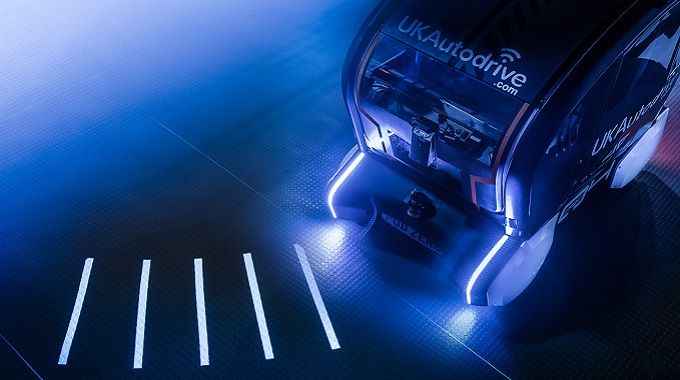
A system that projects the direction of travel onto the road ahead of self-driving vehicles to tell other road users what it is going to do next has been developed by Jaguar Land Rover.
The intelligent technology beams a series of projections onto the road to show the vehicle’s intentions – for example, stopping and turning left or right – as part of research into how people can develop their trust in autonomous technology.
The projections could even be used to share obstacle detection and journey updates with pedestrians, the company says.
They feature a series of lines or bars with adjustable spacing. The gaps shorten as the pod is preparing to brake before fully compressing at a stop. As the pod moves off and accelerates, the spacing between the lines extends. Upon approaching a turn, the bars fan out left or right to indicate direction.
Trials were set up by a team of advanced engineers, working in Jaguar Land Rover’s Future Mobility division, supported by cognitive psychologists, after studies showed 41% of drivers and pedestrians are worried about sharing the road with autonomous vehicles (AVs).
The innovative system was tested on a fabricated street scene at a Coventry facility with engineers recording trust levels reported by pedestrians both with and without projections.
The trust trial programme – which also included fitting of ‘virtual eyes’ to the intelligent pods in 2018 to see if making eye contact improved trust in the technology – was held as part of Jaguar Land Rover’s government-supported UK Autodrive project.
The new technology under development is designed to break down any initial apprehension pedestrians may have with the introduction of more advanced self-driving cars, Jaguar Land Rover NZ general manager Steve Kenchington says.
He says that pedestrians look for cues from drivers to ensure they have their attention before venturing out onto the road, but in the case of self-driving cars other ways will need to be found to reassure pedestrians it is safe to cross.
“In the coming years we will see a rapid increase in the number of self-driving vehicles on our roads.
“While this technology has been developed to make driving safer for drivers and pedestrians, we have become accustomed to using eye contact with a driver to make a connection and yet 94 pedestrians were killed on our roads last year – with many more seriously injured.
“An essential part of the technology’s successful integration into our society will be the development of intuitive methods of communication between road users; in the same way we have used hand signals and indicators to communicate with others for generations.”

Join the conversation