
Car battery storage systems stabilise the power grid
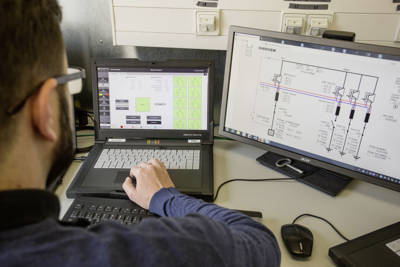 Mercedes-Benz Energy and German electricity producer TenneT have formed a partnership to jointly research and test the feasibility of using car battery storage systems in the power transmission grid.
The results have found that car battery storage systems can actually take over tasks from large-scale power plants, and make a significant contribution towards power grid stabilisation and system recovery.
Thanks to project funding from the German Ministry for Economic Affairs and Energy, Mercedes-Benz Energy and TenneT have shown that car battery storage systems that use a lithium-ion basis, can also be used for highly dynamic system support and system recovery – specifically for a black start in power plants and to support mass inertia. Ultimately, this can help to compensate for the loss of conventional energy generation.
For the development partnership, the prototype of a battery storage system made up of automotive batteries with a total connected load of approx. 1 megawatt (MW) and a storage capacity of 750 kilowatt hours (kWh) was installed at the Mercedes-Benz Energy test centre in Kamenz. These are second-life and replacement batteries.
Electricity production is becoming considerably more volatile due to the increasing in-feed of weather-dependent forms of renewable energy. In the power grid, generation and consumption need to be balanced in order to maintain a frequency of 50 Hertz. If this is not the case, frequency deviations can occur.
The masses of large-scale power plants, which rotate in synchronisation with the grid frequency of 50 Hertz, ensure that these fluctuations are dampened so that the system responds to these deviations in a more inert way. This is important, as frequency deviations can only be compensated with a delay through primary balancing power. Without the inert masses in the grid, the frequency would change so quickly that no compensation through balancing power would be possible.
This would lead to ever-greater frequency deviations, which in the worst-case scenario could cause power failures. At the Mercedes-Benz Energy test lab in Kamenz, the project partners have now shown that car battery storage systems can respond to a changing frequency in less than 100 milliseconds. This means they can replace the inert masses in large-scale power plants.
The partners have also shown that battery storage systems can be used to start up energy generating assets and even entire power stations, for example after a large-scale power failure.
Today, diesel power units are used to restart turbines in power stations (rotating masses) and supply power to auxiliary units. The development study shows that this can also be done with battery storage systems – with virtually no losses and in a process that is much better for the environment. The energy storage system acts as a kind of “starter battery for the energy supply” and restarts the inert rotating masses of a power station. The necessary energy, around two to four percent of the rated capacity of a power station, is retrieved from the energy storage system if needed.
To prove this, the partners constructed a test grid in Kamenz and restored it after a simulated power failure using the car battery storage system.

Join the conversation