
Cars and humans share smarts
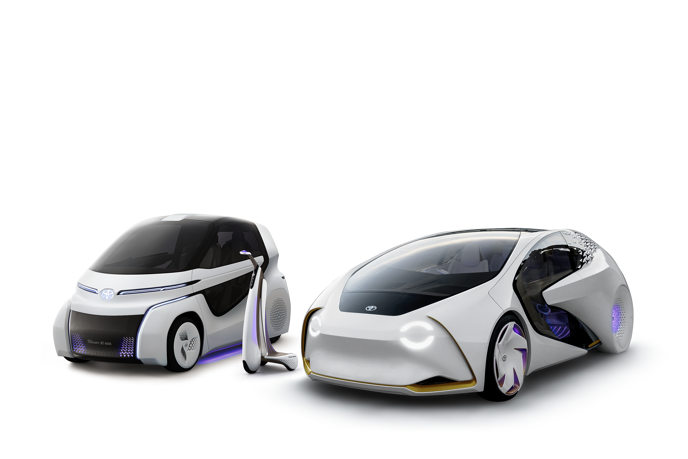
Having an electric car that understands, talks with and learns from people sounds like science fiction, but Toyota reckons that will soon be reality.
A family of three concept EVs applying artificial intelligence (AI) to recognise emotions and estimate driver preferences, combined with automated driving technology for maximum safety, will be displayed at the Tokyo Motor Show from October 27 to November 5.
They expand on ideas from the four-seat Concept-i revealed at the International Consumer Electronics Show in January.
The three Concept-i series vehicles, from left, the RIDE, WALK and Concept-i.
Toyota has now added the Concept-i RIDE, a two-seat vehicle designed to include wheelchair users and the elderly.
Additionally, the Concept-i WALK- a vehicle for pedestrian areas – has been added to the series to enable free movement on footpaths.
All three concept cars feature the AI Agent – the name for the function which can understand people.
It provides appropriate responses and actions to a driver’s questions or requests using voice recognition, anticipates the driver’s needs by monitoring and protecting the driver, initiates communication and offers advice.
The Toyota Concept-i can determine a driver’s emotion and alertness by reading expressions, actions and voice tone.
It estimates the driver’s preferences by comparing general information such as web news with information on individuals such as social media activity, GPS information, and conversation history in the car.
Concept-i constantly monitors the driver’s condition and the car, enabling it to switch to automated driving if the driver is overcome by a dangerous or high-stress situation.
It will stimulate the senses to rouse drivers when they feel drowsy, and help them feel relaxed at times of higher stress.
Its AI Agent technology engages in conversation based on the driver’s emotions and preferences. The car suggests topics of interest based on the driver’s mood.
It also creates an “emotion map” by periodically plotting the driver’s emotion and GPS data. Using this information, the Toyota Concept-i series can deliver fresh experiences by suggesting new, enjoyable routes.
The vehicle design projects a futuristic silhouette and a simple and open interior, with the Agent at the instrument panel centre. A 3D heads-up display also provides intuitive interaction with the Agent
Toyota plans road tests using some of the Concept-i functions in Japan by about 2020.
The company says has the car has a 300km range.
Gull-wing doors, an electric universal sliding seat and a joystick allow easy wheelchair access in the Toyota Concept-i RIDE, with a range of 100km-150km.
The AI Agent provides information supporting and enhances outings, such as the location of barrier-free facilities.
The driver’s seat is at the centre when one person is driving. Toyota also envisions this vehicle participating in ride-sharing services.
Offering short-distance movement, the compact scooter-like Toyota Concept-i WALK has a cruising range of 10km-20km.
Incorporating three wheels, a wheelbase variable mechanism and a steering function, it can rotate on the spot and its low floor enables easy access.
Conversation with the Agent and data are obtained from sensors in the handles.
If the vehicle senses danger while moving, it warns the driver and takes avoidance measures.
Join the conversation