
Challenges face electric leisure boating
 A market-leading supplier of electric outboard and inboard drives for leisure boats and small fishing boats, Torqeedo recently surpassed 100,000 electric boat drive sales.
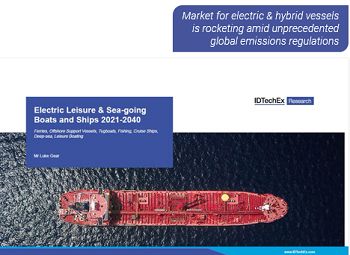
What’s remarkable about this achievement is that it has largely been met with little to no financial incentives or regulation on outboard or inland vessel emissions, which are both key drivers for other EV segments, says IDTechEx which has updated its report Electric Leisure & Sea-going Boats and Ships 2021-2040.
As a result, growth has been steady, but also slow and the electric boat market is not taking off in the same way as other EV markets like passenger cars, the report says.
Part of the apathy towards restricting boating emissions is down to prioritising the largest problems first, it adds.
While emissions per outboard can be over 30 times the missions per car, the scale of the problem is still much smaller – no more than 500,000 outboards are sold yearly compared with about 80 million cars.
Allowing boats a free pass on emissions undermines the massive effort from other industries, and ultimately will lead to a more difficult transition down the line, IDTechEx says.
The report highlights some of the key challenges remaining to bring electric leisure boats into the mainstream.
These include no incumbents on the market – resulting in start-ups like Torqeedo creating and driving the electric leisure boating market almost single-handedly, a lack of emissions regulation, and high battery prices.
System-level maritime battery prices are several times higher than those of other industries such as electric cars and stationary energy storage, the report says.
It provides historical data from 2016 and forecasts up to 2040 in the number of electric vessels, battery demand (MWh) and market value broken down by pure electric and hybrid powertrain as well as by each marine sector – leisure boats, fishing, cruise ships, ferries, offshore support, tugboats and deep-sea.
This report also forms a part of the broader electric vehicle and energy storage research at IDTechEx, tracking EV adoption, battery trends and demand across more than 100 different mobility sectors, summarised in Electric Vehicles 2020-2030: 2nd Edition.

Join the conversation