
Charging on to the water
New Zealand electric ferries, ships, and boats are making huge waves in the marine industry.
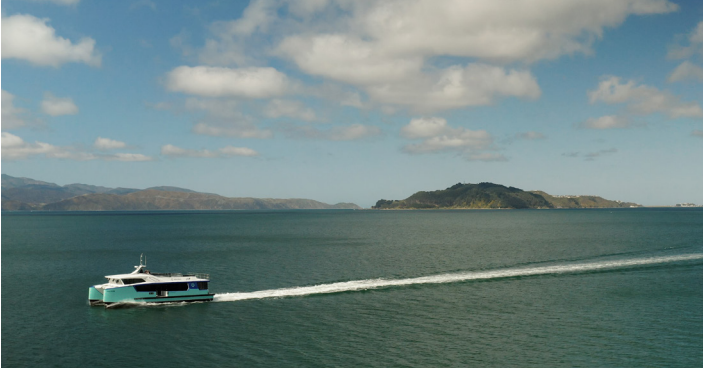
First out is Wellington’s East by West Ferries’ Ika Rere, launched on December 16 and scheduled to enter service in the New Year.
In sea trials it has performed as predicted, even exceeding performance in some areas, East by West reports.
The high-speed passenger ferry was put in the water in Wellington earlier this year, and is the first in the southern hemisphere
The 19-metre battery electric 20 knot ferry will transport commuters and tourists on the established East by West Queen’s Wharf to Days Bay route.
The Ika Rere can carry up to 135 passengers, with three crew, has an on-board café, two toilets, and inside and outside seating.
It has been designed and built to complete one return run of 25km before charging at the dockside at a rate of 1MW for 15 minutes, while passengers disembark and board.
As world focus turns to how transportation can reduce its environmental impact, East by West Ferries chief executive Jeremy Ward knew he had to do things differently when it came to buying a new ferry for his Wellington Harbour route.
“East by West has been running this route for over 30 years and when we decided an upgrade was needed, we knew it was time to think outside the square.
“We had to find a solution that was going to tick all the boxes – not just revenue and performance and customer experience, but also meeting our responsibility to the environment,” Ward says.
“We knew we had to be bold and take action now, rather than talk about electrification as though it’s a future dream.
”Ward partnered with Fraser Foote to set up the Wellington Electric Boat Building Company, and together they launched the 19m catamaran Ika Rere (flying fish).
“Designing and building a boat of this complexity isn’t for the faint-hearted, but we took the plunge, got the right people on board, and just got the job done,” Foote says.
He knew he had the composites manufacturing and project management experience but needed a team of experts in specific fields.
He found technical partners in McKay (electrotechnology specialists), SSC Marine (naval architecture and design consultants), Gurit (composites and lightweighting), and Retyna (EV consultants).
For the first year of operation, it will be charged from a 300kW charger at its overnight berth using the same specification as the high-power EV chargers used by ChargeNet in Taupo and the Bombay Hills.
The catamaran has 540KWh Installed battery capacity, 750 Volts DC distribution, 5.
5 tonnes battery weight, and two 325kW propulsion motors.
Efficiency and weight have been critical considerations with WEBBCo working closely with key design and technology partners.
Energy consumption followed by maintenance are the largest costs for a conventional ferry operator – easily four or five times the purchase price.
Electric propulsion reduces operating costs with the energy costs being about half that of diesel per kWh.
However, the onboard Energy Storage Systems (ESS) required to achieve endurance (distance and speed) are typically heavy which increases energy consumption.
First, SSC Marine identified the total maximum displacement for the mass of battery required to deliver the operating power, for the required speed and targeted recharge frequency.
The hulls had to be as slender as possible to achieve minimum resistance to reduce the energy required to move the vessel through the water, but also had to accommodate the batteries.
Once the principal dimensions and battery mass were determined, the rest of the vessel could be detailed, including construction materials and manufacturing processes.
Gurit and SSC Marine went for high-strength low-weight carbon fibre to compensate for the weight of the energy and power systems, producing a boat that was lighter and more efficient than a diesel aluminium vessel.
A modular construction process relied on digital manufacturing and using composite flat panels for the topsides and deck.
The pre-made carbon fibre and foam core panels were CNC cut to the required shapes and shipped to WEBBCo for assembly.
To achieve optimal shapes and expected through-water performance, the hull bottoms were produced from moulds.
The electric propulsion and power management system was custom developed and designed by McKay for the East by West route and charging infrastructure.
The electrical distribution system is based on a DC bus concept, and power is distributed around the vessel at 750VDC which minimises conversion and distribution losses.
The propulsion inverters and motors allow for 97% efficiency from distribution grid to propeller shaft.
The vessel’s batteries are arranged in redundant systems, with independent battery stacks in each hull.
The advanced battery management system (BMS) provides constant system supervision, enabling safety functions as well as real-time system capacity and health data.
An advanced algorithm supplies a constant estimate of the vessel range, using benchmarked conditions and real-time feedback of the vessel’s performance.
The VCAM provides the skipper and crew with dynamic visual performance data and an overview of all the vessel’s systems at any time, allowing them to make optimal operational decisions.
Though the electrical system has been optimised for a typical commute, at lower speeds, the ferry can operate for longer distances and times between charges.
That allows East by West to charter the ferry for dinner cruises and sightseeing trips.
WEBBCo and East by West worked with Retyna on the coordination of the land-side charging infrastructure, including wharf strengthening requirements, supplier selection, and permissions.
There are plans to use the forthcoming Megawatt Charging System (MCS), from the same family as the CCS-2 charging standard, once charging equipment using that reaches the international market.
It will enable Ika Rere to do all of East by West’s daily time-tabled sailings.
The MCS standard has been delayed by COVID-19 and is the same standard that will be used for the Tesla semi trucks.
Daimler, Hyundai, Mercedes-Benz, and Volvo are other truck and bus manufacturers developing and testing vehicles with MCS charging.
Local electricity network capacity, access, viewshafts, aesthetics, and dockside infrastructure were equally important, as the dock is in a heritage area with restaurants and waterfront walkways.
Retyna project-managed a solution that meets the ferry’s current charging needs, and is future-proofed, ready for further electrification of Wellington’s public transport.
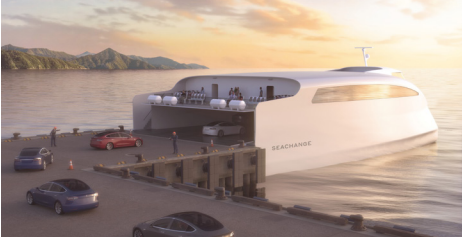
Wellington – or more particularly Cook Strait – is also the scene for a 30-passenger and six-car electric foiling ferry called Seachange Foil 24 (it’s 24m long) due for trials in mid-2023.
The fully carbon fibre vessel with submerged hydrofoils (with the propulsion mounted on the rear foil) is a prototype for a probable 40m long ferry carrying 250 passengers and 20 cars on the Wellington to Picton run, doing it under two hours before returning.
The Seachange prototype is expected to have a 120km range (single trip) at 60km/h or about 32 knots The foils lift the hull about five metres above the water to ensure smooth sailing on Cook Strait’s often rough seas, Seachange New Zealand Ltd chief of staff Fred King says.
The foiling ferry’s big batteries will be charged at Wellington and Picton between turnarounds, and the ferry will incorporate plenty of new technology.
Based at Mt Wellington in Auckland, Seachange has about 25 full-time engineers and boat builders working on the foiling ferry project.
The team includes several members from America’s Cup teams and Sail GP, with their ferry using technology that has been developed in competitive sailing.
King says people will be able to prebook their place on the first sailings across the Cook Strait on the coimpany‘s website where they can also get more information.
EV Maritime co-founder and chief executive Michael Eaglen expects its first electric ferries on Auckland’s Waitemata Harbour by late 2023.
Eaglen stepped down as McMullen & Wing chief executive after eight years to establish the EV Maritime business in partnership with the same company.
EV Maritime is advancing research and development towards getting electric ferries operating in Auckland and surrounds.
“Our vision has been to play a leading role in Auckland becoming one of the world’s first cities to enjoy a significant fleet of battery-electric fast commuter ferries, and ultimately for Auckland to become a model for decarbonisation of harbour cities around the world,” Eaglen said in announcing EV Maritime in November 2019.
Auckland’s largest ferry operator Fullers 360 contributed financial and practical assistance towards the electric ferry effort.
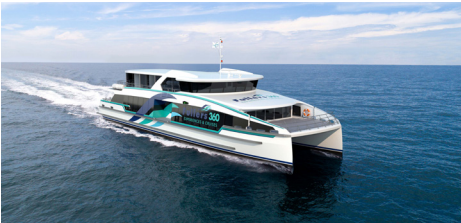
The planned 24m-long e-ferry is known as EVM200 and can carry 200 passengers at 25 knots.
Eaglen says EV Maritime will provide zero emission maritime innovation from New Zealand to the world.
The company plans to have a presence at suitable overseas shows once COVID-19 restrictions ease.
Though the Auckland Boat Show is set to return on March 17-20 at the Jellicoe Harbour former America’s Cup team bases, Eaglen says EV Maritime doesn’t plan to exhibit there.
“Nor do I see us exhibiting at other New Zealand shows – they’re all quite focused on the recreational sector, which isn’t our market.”
The show has developed a reputation as a hub for new releases and marine industry innovations.
The October 2021 show was cancelled due to COVID restrictions and organisers say moving to March will take advantage of Auckland’s summer boating season and the event will be bigger than previous ones.
One Auckland company planning to be there is ZeroJet, which aims to remove the need for combustion engines on new boats under six metres.
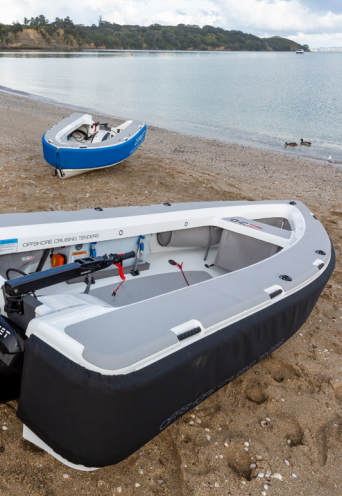
It built the world’s fastest jet board in 2018, and in 2019 teamed up with Offshore Cruising Tenders to produce the world’s lightest electric jet tender.
Rather than being involved in boat production the main aim is to specialise in supplying the electric jet system to boat builders around the world.
ZeroJet plans to get a few more electric jet boats out before Christmas.
Recently moving to new facilities in Mt Wellington and launching its 14kW ZJ20 electric jet system, ZeroJet has also gained traction internationally.
The ZeroJet propulsion unit is an inboard system operated by a tiller arm or steering wheel console control depending on the boatbuilder or customer’s requirements.
Its system has been integrated into the OCTender range, offering superior manoeuvrability and capable of reaching 20 knots.
Taking one 20hp four-stroke outboard off the water is the equivalent of taking 150 cars off the road, says ZeroJet.
“Our plan is to build a future that is more fun, more convenient and better for our planet.
“It’s also far from the world we live in today where nearly all boats still run on fossil fuels, but with your support and our talented team we believe we can be leaders in making this happen.”
ZeroJet can tailor its system to the individual needs of each vessel, providing a turnkey OEM solution.
It intends to sell 100 OC Tenders with ZeroJet electric systems.
These tenders – mainly used for access to larger motherships – will also be on display at the Auckland Boat Show.
Growing enquiries are being received from environmentally conscious customers looking for a small day/trailer boat they can launch from their bach or local beach.
Sailing, rowing, swimming schools seeking an environmentally friendly solution to traditional ICE coaching boats are also showing interest.
Fullers360 aims to have a high-speed plug-in electric hybrid ferry ready in 2023 for Auckland’s Hauraki Gulf ferry network.
It can transport 300 passengers between Devonport and downtown Auckland where it will operate at 100% electric, with capacity to travel to other destinations as needed.
“Our vision is to provide New Zealand with the opportunity to build and operate the world’s first large-scale fast ferry fleet, supported by a fleet of hydrogen-ready electric vessels,” Fullers360 chief executive Mike Horne says.
“The move to green ferry technology is a significant milestone in realising our long-held vision and commitment to delivering sustainable marine transport for Auckland and other regions.”
The new electric hybrid vessel is being built by Q-West in Whanganui, construction starting in April 2022, and will feature a world-leading electric-hybrid propulsion control system from HamiltonJet.
Join the conversation