
Charging strategy welcomed by EV industry leader
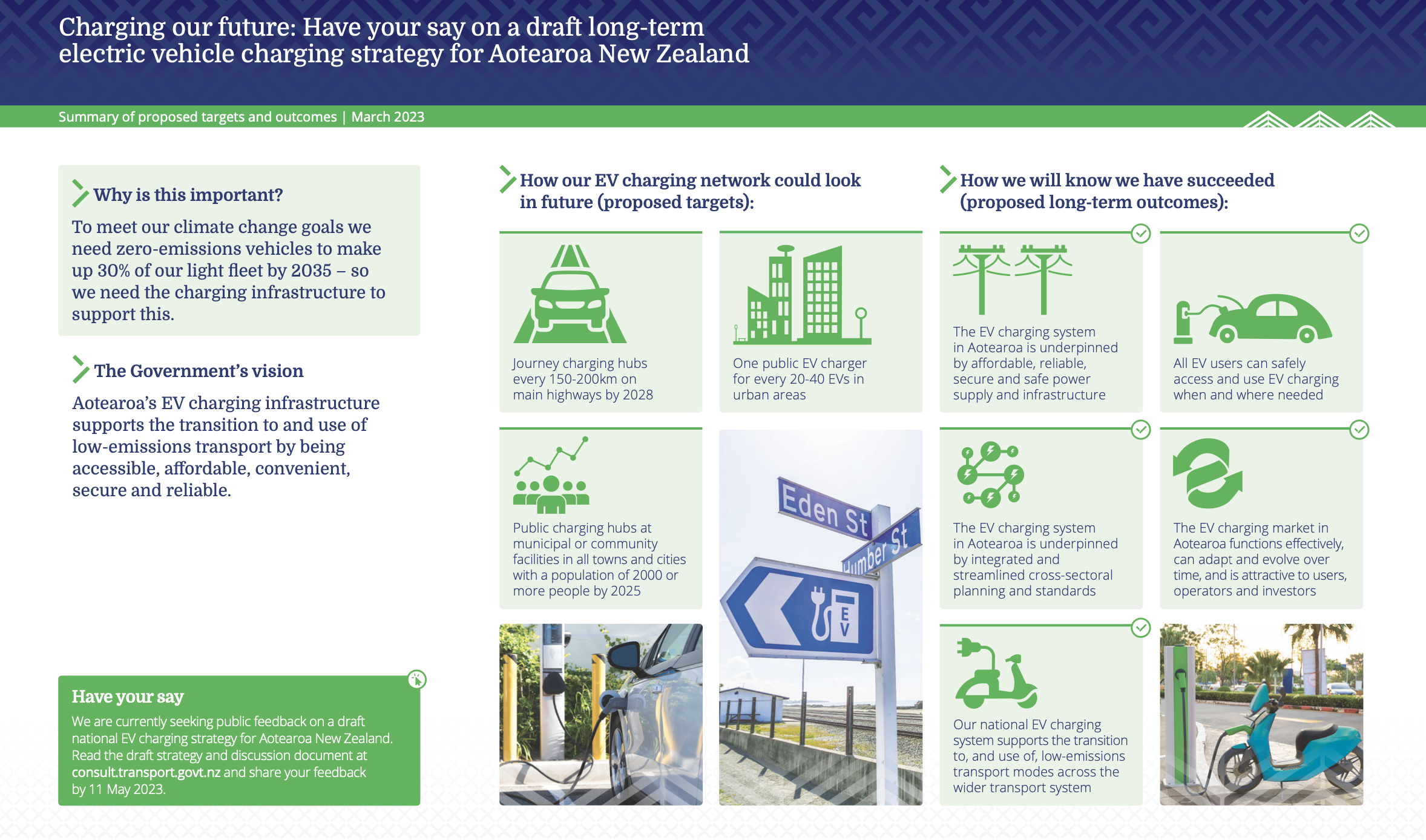
The Government has released its draft national EV charging strategy, with ambitious targets for how it sees infrastructure rolling out in coming years.
The draft strategy, released for consultation on March 22, includes a range of initiatives, including targets to provide journey charging hubs every 150-200km on main highways, a public charger for every 20-40 EVs in urban areas, and public charging at community facilities for all settlements with 2000 or more people.
The hub proposal would result in a network of about 25-34 hubs with each hub containing up to 20 chargers. Each hub would be akin to a petrol station for EVs, offering services to customers while they wait to charge their vehicles. It is well known work is underway on plans for a trial hub north of Wellingon.
It calls for an initial focus on light vehicle charging. The draft plan is available now, with documents and a summary available on the Ministry of Transport’s website.
Submissions are also open now, closing on May 11, 2023.
ChargeNet, Aotearoa New Zealand’s nationwide EV charging network says the plan is “a step in the right direction”.

Chief executive Danusia Wypych says the country’s only end-to-end network is ready to continue investing in public infrastructure to support communities and drivers to adopt EVs.
“ChargeNet is continuing to invest in new sites across the country, as well as strengthen our existing sites to accommodate more EVs, but as a whole New Zealand is lagging behind the rest of the world in our delivery of charging infrastructure,” she says.
“We have been investing heavily in our network for seven years, and we are now starting to see some sites that are commercially viable in their own right. The scale of investment required across New Zealand means the EV charging strategy must be supported by the industry, with focused financial commitment from Government to see our adoption of EVs, and carbon reduction continue at pace.”
Wypych says that ChargeNet is expecting to see a million EV charging sessions occur at its sites over next 12 months, so it is critical that a strong investment pathway is maintained to support EV drivers.
“With the increased registration of EVs and increasing we are seeing some sites double the amount of electricity they are delivering,” she says..
“With a need for charging sites that can accommodate more EVs, as well as an increase in the number of locations, we anticipate across the industry over $400 million of investment could be required for EV charging infrastructure over the next five years. In some communities, essential investments will not be fully commercial at this time for the location or scale that makes sense for the long term, and we look forward to seeing a well considered funding strategy to complement the draft strategy.
“The time to commit to infrastructure is now. If we truly want to achieve our national ambition of a net zero emissions economy, we must continue to incentivise the rapid uptake of electric vehicles, strong public charging infrastructure, off-peak electricity use, and create access for all households,” she says.
“The key to getting people to transition to electric vehicles is user experience keeping things, fast and simple will reinforce the positive experience.”
“We support the Government’s proposal to provide journey charging hubs on main highways and are already working towards this as we grow our network. There is a real opportunity to integrate these into towns and communities that can provide amenities and services to drivers.
“Overseas experience suggests charging hubs can end up isolated, and we’re fortunate in New Zealand to have so many community locations that can serve both local EV uptake, and those drivers travelling throughout the country. The Government strategy presents a unique opportunity to create meaningful connections between these communities and the travelling public.”
The vision is for New Zealand to have world-class EV charging infrastructure that is accessible, affordable, convenient, and reliable, says transport minister Michael Wood of the national EV charging strategy Charging Our Future.
“Emissions from our light vehicle fleet are the single largest source of transport emissions in New Zealand, partially due to having some of the most fuel inefficient and emissions intensive vehicles in the OECD,” Wood explains.
“This costs Kiwis at the pump and is damaging to our health and the environment. Switching to EVs would be like buying petrol for 40c/litre, which would make a big difference for household budgets.
“Meeting the targets would see tens of thousands more EV chargers across the country,” says Wood.
“These new targets carefully balance facilitating infrastructure to support different trips and journeys that EV drivers make, while ensuring that rural and provincial New Zealand locations are accessible for residents and visitors with EVs.”
Wood says the Government’s Clean Car policies’ success sees more than 69,000 EVs on the road – at least 80% more than at the end of 2021.
“This strategy will ensure we can sustain the uptake of EVs as we see more people making the switch,” he adds.
“To make sure the strategy is effective we’ll be collaborating with local government and industry across transport, energy, and other sectors to deliver on these initiatives.”


Join the conversation