
Children loving their Gobabygo wheels
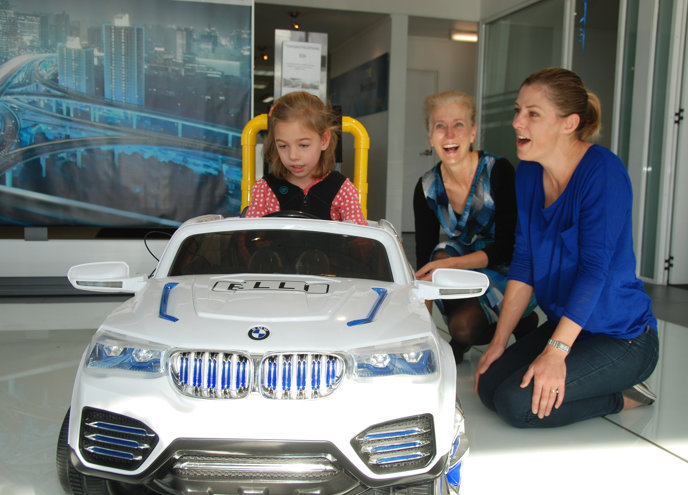
Jacqui Madelin realised the value in giving children greater mobility when she saw a YouTube clip about United States paediatric researcher Cole Galloway who’d studied the effects of immobility on small children.
He’d realised how dramatic those effects were when children with impaired movement were given the means to get about independently and pioneered an affordable method to adapt toy ride-in electric cars.
“Kids who are mobile find it easier to make friends, relate to their brothers and sisters; they learn boundaries and even their cognitive pathways improve,” Madelin says.
“Young children given independent mobility improve their confidence and gain greater freedom using these cars.”
Better still, instead of being the outsider “they become the cool kid with the cool toy!”
Madelin thought the concept could work well in New Zealand and knew just the man to help.
Mark Prujean agreed and within months a small board was formed and started the process of putting the first Kiwi kids into a Gobabygo car.
Galloway, a professor of physical therapy at the University of Delaware, has since visited Gobabygo NZ.
“We studied mobility and immobility, and how that impacts a child’s ability to learn and socialise with peers, and what we see is a striking difference,” he says.
“Fun is key as it unlocks brain development and a child’s exploratory drive, while sparking active, engaged play from adults and peers.”
Galloway and his students developed a reliable and affordable way to modify off-the-shelf toy cars so children who can’t crawl or walk normally can become part of the action at home, at kindergarten or in playgrounds.
And he made the system available to parents and medical people worldwide.
The New Zealand organisation was one of the first to form, in August 2014. It became an incorporated society with a board of six volunteers – including Madelin – overseeing GoBabyGo here.
The first three cars were provided to a child with heart disease whose mobility is severely limited by fatigue without the car and who can now keep up with her siblings; a child with a chromosome abnormality that meant at age three she was smaller than her one-year-old brother; and a six-year-old with cerebral palsy.
Soon after, specialists in child therapy and behaviour here quickly realised the value of the cars.
“Once they’d seen the effects on these kids and how easy it was to adapt the cars, we knew we had something to carry on with,” Madelin says.
GoBabyGo NZ began working with hospitals and organisations such as Kidzfirst Children’s Hospital and Nelson Hospital before rolling the programme out to the rest of the country.
It donated 50 cars in the first year, 70 in the second and aims to increase that each year until every eligible child from 18 months to around seven years has a Gobabygo car.
By early July it had 162 kids on its books.
Prujean manages the cars and adaptations.
“Nearly all the kids need a harness and backrest, and a remote is available so parents can help with control,” he says.
Some children need the throttle on the steering wheel or in the headrest. Others need the remote to move but are able to steer using extra handles affixed to the wheel.
“The cars can even be adapted to take a specialist wheelchair seat, which clips to the special frame, or to a car seat base, or to the wheelchair, so the child always has the support it needs.”
Children using the cars include those with cerebral palsy, muscular dystrophy, Downs Syndrome – which can delay development – heart conditions, developmental disorders and more.
Once an application comes in, a small team establishes each child’s specific requirements alongside their doctors, therapists and parents – such as whether they need encouragement to sit upright.
Then stop, go, steering and protective adaptations are tailored to suit the individual child.
The cars themselves are bought from a factory in China, which supplies a standard, New Zealand-approved specification, a container-load at a time to keep them cost-effective.
The battery takes a night to charge and lasts about two hours, which is sufficient for most recipients with their limited stamina.
Gobabygo NZ chief executive officer Gilli Sinclair says New Zealand has a good disability equipment funding scheme but children and families are often not ready to go into wheelchairs and powerchairs.
Such disability equipment can also set a child apart from siblings or same-age peers. But an age-appropriate ride-in electric toy encourages interaction with siblings and friends, and often encourages children to improve muscular control, for example.
Run by volunteers, the organisation relies on donations to pay for cars and adaptations so there’s no cost to families involved. It has picked up some sponsors – such as BMW NZ and Zyber – and benefits from Rotary fundraising.
“Just last week Oxford Finance, part of the Turners Group, handed us a $3500 cheque raised by its employees,” Madelin says.
“But more sponsors are needed as are volunteers in the regions who can help identify kids in their area and hand over their local cars.”
For Madelin, the reward is seeing the expression on a child’s face when they first get behind the wheel – and seeing a mum’s face when she realises all her children can now play together.
Visit gobabygo.org.nz or Facebook.com/gobabygonz for more
information and sponsorship details.

Join the conversation