
China enforcing EV safety by 2021

Thermal runaway of lithium ion batteries in EVS is a main cause of fires and a major concern for consumers, manufacturers and regulators.
On May 12, China issued three mandatory standards for the safety of EVs and their batteries due to be enforced in January 2021.
The three new standards relate to the EV battery, the EV itself and electric buses, says IDTechEx technology analyst Dr James Edmondson, adding similar standards could begin to be enforced globally.
The battery regulations emphasise an improvement in battery system safety regarding thermal diffusion, external fire, mechanical shock, simulated collision, thermal and humidity cycling, external short circuit, overcharge and over-temperature, he says.
This covers the main causes of thermal runaway or fires in batteries.
Additionally, thermal runaway of one cell should cause no fire or explosion in the cabin for at least five minutes, allowing occupants to escape.
The battery system is required to notify vehicle occupants of a thermal incident immediately. More stringent requirements for preventing water ingress, ensuring proper insulation and battery monitoring are also included.
An electric bus naturally has a larger battery and the new standards have more rigorous demands on battery casing collision, charging and water ingress. The standards request appraisal of the flame-retardant performance, thermal runaway prevention and the battery management unit, Edmondson says.
Until now specific EV safety regulations have had voluntary compliance, which has led to a wide variety of battery design and thermal management strategies across the various EV sectors.
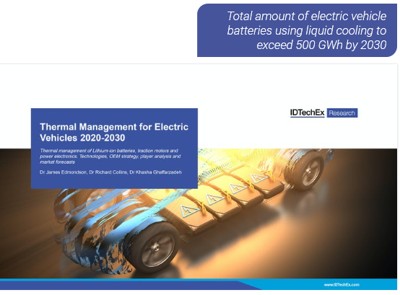
According to IDTechEx’s research outlined in Thermal Management for Electric Vehicles 2020-2030, more than 500GWh of EV batteries will be liquid cooled by 2030.
However, this leaves much of the market utilising other methods, it warns.
Manufacturers have varied between cylindrical, pouch and prismatic cells with air, water-glycol, or refrigerant based cooling.
As regulations like these are enforced it may well push the industry towards one solution, Edmondson suggests.
“For example, preventing propagation of thermal runaway between individual cylindrical cells is much more difficult than between separate pouches. Emerging technologies like immersion cooling, where the cells are immersed in a flame-retardant dielectric fluid may start to take a larger share of the market.”
Detecting thermal events in vehicles is also a widely unexplored area, he says.
There are several potential solutions to detection of a thermal event, including temperature spikes, gas ejection and voltage drops – to name a few.
Another consideration is how to notify passengers and if an active method of extinguishing the battery pack is incorporated into the design.
“Crucially, all the methods have their limitations and it is imperative to avoid false positives and potentially extinguish a battery which is working correctly, as this is often the most expensive component in the vehicle.”
The new standards open opportunities in materials for battery enclosures.
The materials not only have to effectively contain a fire but must also prevent water ingress and have a strategy to deal with a puncture or damage to the enclosure, Edmondson says.
”Manufacturers will have to either adapt their current designs or develop new ones.”



Join the conversation