
Consensus needed to reduce emissions
 Agreement is needed across political parties and industry to cut New Zealand’s transport emissions.
That’s the call from Instructure New Zealand following a report through sustainability advisors Thinkstep which says up to 90% of our transport carbon footprint can be reduced by 2050 using new vehicle technologies, behavioural change and renewable energy investment.
“The Government should move quickly to develop an agreed roadmap with the opposition, councils and business to replace the conventional vehicle fleet with electric and renewable fuel vehicles,” Infrastructure New Zealand chief executive Stephen Selwood says.
He says the report shows up to 88% of New Zealand’s 2015 transport carbon emissions can be eliminated by 2050 by shifting the light vehicle fleet to electric and trucks, trains, boats and planes to hydrogen or biofuel.
“With greater ride sharing, public and active transport, New Zealand can reduce emissions by a further 2%, indicating that a top transport priority for the Government should be facilitating the shift from conventional to electric and other renewable fuel vehicles.”
“If the Government sits down with all the key stakeholders, we may be able to reach early agreement on when and how to accelerate the shift, supporting a much faster transition,” Selwood says.
“Private vehicle owners, car dealers and infrastructure owners, including fuel retailers and the electricity industry, need to know now what New Zealand’s transport energy programme is and how fast the country wants to move. Agreement on the path ahead must be bi-partisan and not owned by any one party or Government.
“Increasing the pace of change will require significant improvement to our planning laws and regulations.”
Selwood says future power supply will include large scale wind, geothermal, solar and possibly tidal power generation.
“Projections undertaken by the Productivity Commission and Transpower show that electricity generation may need to increase by between 50% and 100% to achieve net zero carbon emissions from transport by 2050.
“The electricity market review underway will need to ensure that regulation and market settings support innovation and enable investment in renewable electricity supply.
“The motor industry is gearing itself to respond and the energy sector is actively exploring biofuel and hydrogen energy systems – no one wants a situation where public regulatory and policy settings are holding back progress.”
Selwood says road pricing policy needs to be aligned so the huge benefit of energy efficient vehicles is realised without compromising the means to fund future transport infrastructure.
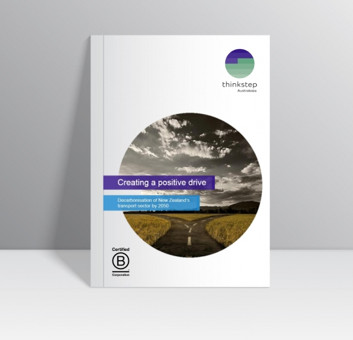
The Thinkstep white paper Creating a positive drive: Decarbonisation of New Zealand’s transport sector by 2050 is available here.


Join the conversation