
Countdown chills emissions with refrigerated EVs
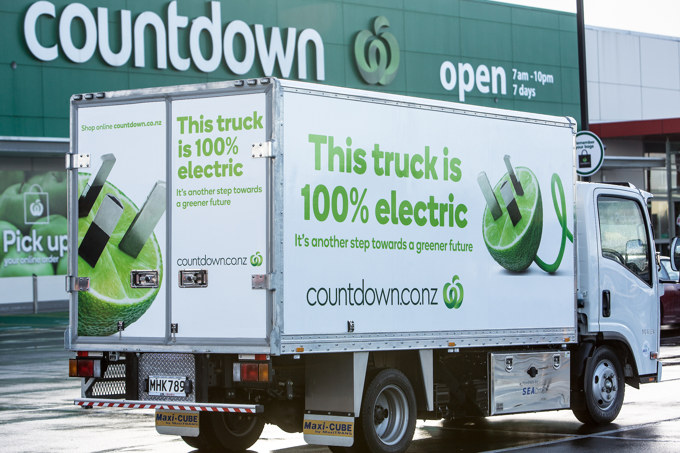
Countdown has introduced the first of five refrigerated electric delivery trucks to its online shopping service.
The EV trucks will eliminate about 135,000kg of carbon dioxide emissions annually.
The new trucks with an estimated 220km range are part of Countdown’s overall drive to lower carbon emissions across its business.
The first truck at Countdown St Johns in Auckland will service customers in St Johns, Greenlane, Remuera, Stonefields and St Heliers.
Four more refrigerated online delivery electric trucks will roll out in Auckland’s Grey Lynn, Newtown in Wellington, Hornby in Christchurch and Queenstown during coming months.
“We believe that electric vehicles will play a really important part of New Zealand’s lower energy future and by investing in electric delivery trucks we’re not only generating fewer emissions, but also helping to future-proof our growing online business,” Countdown safety and sustainability general manager Kiri Hannifin says.
![Countdown Kiri and the EV truck[14118]](https://evsandbeyond.co.nz/wp-content/uploads/2019/08/Countdown-Kiri-and-the-EV-truck14118.jpg)
“In the last three years we’ve reduced carbon emissions across our business by almost 15%.”
Each EV truck has a refrigerated unit, including a separate freezer compartment, to ensure food safety and quality.
“There are some additional complexities running refrigeration in an electric vehicle, however given our commitment to move towards a low carbon economy, this investment felt right,” Hannifin says.
The cost of the five trucks is about $700,000, part of the cost met in converting diesel trucks to electric through a Government low emission vehicles contestable fund grant of $387,500 last year.
Countdown also introduced an EV charging station at its support office last year and launched 15 charging stations in five of its Hamilton stores, offering the service for free.

Join the conversation (1)
Hi Geoff,
Good for Countdown here;
But we still need to find a new ‘safe oil free tyre composition’ here, as truck tyres emit high amounts of “micro/nano plasics new overseas studies have fouund.
Countdown have a large store in Napier alongside our rail line as do Packnsave do also and we would like to see both these stores switch to shipping there goods by rail as rail has no tyres and has very low greenhouse emissions and rail can also be switched to electric powered engines too as Eupope are doing this with rail now so should we.
Meantime good for Countdown our family will shop there now because of this.
Read our article we posted on tyre dust pollkution as it is revealing about the issue that our media have never considered till now.
https://www.scoop.co.nz/stories/PO1908/S00315/report-says-tiny-plastic-particles-are-from-clothing-tyres.htm
Report says tiny plastic particles are from clothing, tyres
Friday, 23 August 2019, 8:51 am
Press Release: Citizens Environmental Advocacy Centre
Report says tiny plastic particles are from clothing, tyres
Press release by Citizens Environmental Advocacy Centre. 22/8/19.
FEBRUARY 22, 2017
https://phys.org/news/2017-02-tiny-plastic-particles-tyres-clogging.html
Quote; – “Tiny plastic particles from clothing, tyres clogging oceans: report”
This report shows that tyre particulates are already found to be freely released in the tyre dust as we drive on our roads now.
Then we are advised these plastic particles are then washed off our roads into our drains, streams, rivers, lakes and aquifers, and finally into our drinking water as we heard all last week over the press.
So we road users are part of the problem now!
Sorry but EV vehicles will still emit the same tyre dust toxins as regular gasoline vehicles do.
So what do we do now?
This new scientific German report https://www.sott.net/article/418585-Plastic-particles-falling-out-of-sky-with-snow-in-the-Arctic
‘Raining plastic’ – QUOTE “fragments of rubber tyres”, signals we need to move now.
Tyre dust pollution was found by lead scientist, Dr Melanie Bergmann in the laboratory at Germany’s Alfred Wegener Institute in Bremerhaven discovered far more contaminating particles than they’d expected.
This clearly shows the gravity of the problems we have with too many oil based synthetic tyres used on our roads now.
These scientific reports are finally making us face reality here to warn us all of very important issues’ – to serious to ignore now.
We need to reduce our over-use of plastic tyres, and our first signal is to lower truck freight and car use now, by using public passenger rail and move at least half our freight movement onto rail.
There are no tyres used on rail, as they use only “steel wheels on a steel track” – ‘making rail virtually the lowest emitter of plastics.’
CEAC is advocating for this Government to use rail to lower freight truck tyre emissions for climate change and our NZ water quality.
ends