
Dendo Drive Station – Powercuts as part of the sales process?
This story first appeared in the July issue of evtalk – CLICK HERE to download the magazine FREE
 Like us Kiwis, the Japanese know a little about natural disasters.
The devastating Tohuku earthquake of 2001, like Christchurch, left thousands of homes wrecked, and millions without services for weeks.
Mitsubishi Motors Japan saw a way they could assist their customers with their – at the time – relatively new electric vehicle product lineup.
The first move was a unit that could be plugged into the Chademo port on the small iMiev and provide power to homes in the event of extended outages.
The next step spread the idea further.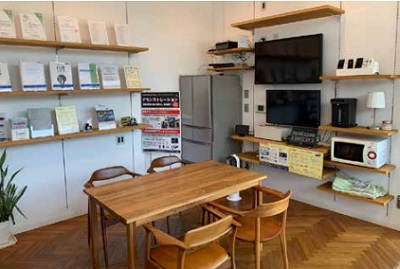
Every Japanese-sold Outlander PHEV came with a built-in inverter capable of supplying up to 1500 Watts at the Japanese-standard 110-120 volts.
Again, the idea being is when the power goes out you can run home basics as long as you have battery charge or even petrol in your tank.
Those 1500 Watts will go a long way, with Mitsubishi sales staff in dealerships demonstrating that this could be enough to run a household fridge, keep devices charged, heat a jug, run a laptop and even run a microwave with a little management.
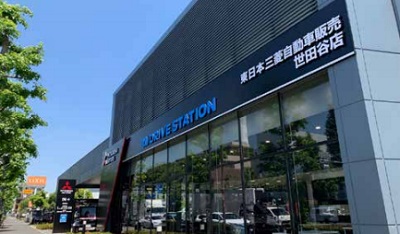
Such demonstrations are part of a Mitsubishi dealer concept called the Dendo Drive Station – a merger of vehicle charging, home technology demonstrations and civil defence operation all rolled into one.
On a recent trip to Japan, EVtalk took a tour of the station in Setagaya, a suburb of Tokyo, with Taku Kawai, manager of domestic network development for the sales and EV solution departments of Mitsubishi Motors Corporation.
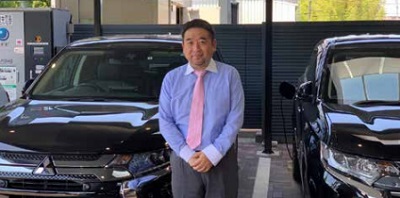
Taku Kawai
Of the 591 Mitsubishi dealerships, 66 (as of the end of May), feature a drive station of some form or another.
The Dendo system includes roof-top solar, DC and AC charging, a V2H unit and a demonstration “apartment” where all the technology comes together.
Overall, 501 dealers have DC fast charging units.
They service a Mitsubishi plug-in fleet of 49,476 vehicles – including the Outlander, iMiev and Miev commercials.
In the apartment, specially trained staff can literally plug in and out real appliances to show the customer how much they can run off their Outlander.
An artificial blackout is triggered, and then you switch to the vehicle supply and add appliances.
It’s an interesting way to sell the concept, and really does break down what can be done with the vehicle’s energy in an easy-to-understand way.
The building itself is partially powered by 3.3kW of solar panels, which feed either into the main building supply, or into a demonstrator Outlander parked on a V2H unit.
Excess energy can be supplied to the grid.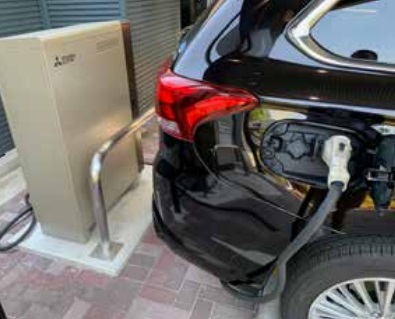
A smaller number of Hyper Energy Stations have also been build which feature more solar, up to 30kW, and a 12kWh battery storage unit.
A small colour display and control unit show how much power is coming in and where it is going – either back into the car, out of the car or in from the grid.
On the day we visit the sun is shining and the dealership is taking full advantage of the solar to power itself.
The ability to be energy independent means that in the event of an emergency, the dealership can be used as a gathering point for the local community.
The main local emergency gathering point is technically in a park across the road, but working with the local government the dealership and its energy will be put to use should it be required.
In its own right, the dealership is an appealing space.
Japanese dealerships are small, and tend to eschew large number of cars inside for people friendly spaces, coffee to order and even play areas for children.
Full height glass walls and high ceilings give a feeling of space and light.
The design of this dealership is similar to the new concept being rolled out in New Zealand, with black exterior finishes and signage.
It is striking and stands out amongst brands.
Mitsubishi believes charging is a way to maintain a connection with the customer, and while most charging is AC at home, it welcomes customers to the dealership to top up.
“Yes, this is a part of the corporations for the development of EV infrastructure as a social action, and it also can be aiming for our EV customer’s satisfaction,” the brand said in a statement.
Kawai is working on developing the sales of V2H systems to customers, both from the perspective of including it in vehicle financing and making it more affordable.
“It is currently too expensive, we are asking for it to be cheaper,” he says.
He prefers to call the unit a “car conditioner” than its more technical name.
Drive station charging is not just restricted to Mitsubishi vehicles, with an eGolf popping in for a top-up while we were at the site.
How much does charging cost? In Japan you tend to subscribe to a membership card.
With Mitsubishi’s, for 50kW DC you pay five Yen a minute at a dealer, up to 12 Yen a minute at non-auto branded chargers and 15 Yen a minute at other automaker’s chargers.
AC charging costs around 1.4 Yen per minute.
Don’t just expect to be ignored when coming into charge either.
When driving an electric vehicle in a rural area we pulled into a Nissan dealership just as it was opening.
Sales staff waved us into the charging slot, plugged us in, lead us into the customer waiting area and offered a coffee.
Considering the charge only cost around $5 it makes for good value – and a strong bond to the brand.
DC prep for Mitsubishi New Zealand dealer
Mitsubishi Motors New Zealand is currently planning on taking on aspects of the Dendo Drive concept for New Zealand.
“Absolutely, in fact we are currently working on a prototype Dendo House.
We are hoping to have more information to share on this exciting project later in the year,” head of marketing and corporate affairs Reece Congdon says.
Already most of its metro dealerships have AC charging for customer use.
“We are also seeing a number of our parts and service dealers also upgrading their facilities to incorporate EV charging,” Congdon says.
“At head office out at Porirua we have 5 AC and 2 DC chargers currently in use.”
DC is being considered for some dealerships, though that comes with challenges.
“We are reviewing 25kW DC fast chargers at dealerships but this requires street transformer upgrades in many locations,” he explains.
“Our new dealership rebuild in Tauranga has been upgraded to enable DC fast chargers to be installed once the new dealership is completed.”
The possibility of making V2H units available to Outlander customers is being considered, but cost is getting in the way.
“MMNZ in very keen to take a leadership stance in this space and see a vast array of opportunities for owners in the future.However, at this current point in time V2H devices are still prohibitively expensive as prototypes.”

Join the conversation