
Dunedin tops EV uptake per head
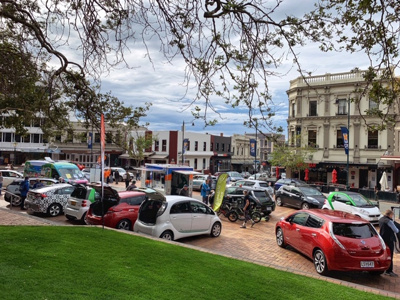
Dunedin has the highest number of pure electric vehicles (EVs) based on population out of New Zealand’s main cities.
It has 3.73 EVs for every 1000 people, with nearest rival Wellington at 3.19, analysis by Carsten Dortans at the Otago University Centre for Sustainability shows.
When both pure electric vehicles such as the Nissan Leaf and plug-in hybrid electric vehicles (PHEVs) such as the Mitsubishi Outlander are counted, Dunedin still just comes out top (4.34), marginally ahead of Wellington (4.33) which has a greater proportion of PHEVs, according to the Dunedin Energy Study, a joint project between the centre and the Dunedin City Council.
Transport uses half of the energy consumed in Dunedin and produces most of the city’s energy-related greenhouse gas emissions, the study reveals.
It shows a total of 13.4 petajoules of energy consumed in Dunedin during the 2018 financial year, a 5% increase from 2017.

Janet Stephenson.
Just over half of the city’s total energy (53%) came from petrol and diesel, 24% from electricity, 13% from biomass (mainly firewood and wood chips), 5% from coal, 3% from LPG and 2% from sulphur.
Centre for Sustainability director associate professor Janet Stephenson says transport energy consumption has grown, and is an important area for action to reduce greenhouse gas emissions.
“However, what is pleasing from an emissions perspective, was to find Dunedin’s uptake of electric vehicles tops all New Zealand cities.
“Electric vehicle ownership is increasing exponentially, going from around 25 in 2015 to more than 500 today. However, this is still a drop in the bucket – less than half a percent of Dunedin’s 104,000 registered vehicles.”
Stephenson says the EV ownership finding is “something for Dunedinites to be very proud of”.
“Electric vehicles have very low greenhouse gas emissions and are also increasingly affordable and cost very little to run. I hope Dunedin can keep leading New Zealand.”
Dunedin’s Electric Vehicles owners’ group representative Pam McKinlay is delighted.
“I think our electric vehicle advocacy and education has probably helped, but Dunedin people are really interested too – we are always in demand for other events and festivals as well as the dedicated EV events we put on.”
Dunedin also has the highest proportion of EVs registered for personal use (as opposed to commercial or other), followed by Wellington and Christchurch.
Dunedin’s personal registrations are mostly pure electric vehicles, again at a far higher rate per 1000 people (3.29) than all other cities (2.3 or less).
Other key findings include about 35% of the energy used in Dunedin over the past year was from renewable sources – slightly less than the national figure of 40% of renewable energy for 2017.
Transport fuels (petrol and diesel) consumed over the past year increased by 9% from the previous year. This follows a 2% reduction in the combined transport fuels in the year prior.
Energy used in the city resulted in about 680 kilotonnes of CO2-equivalent greenhouse gas emissions, most of it (74%) from petrol and diesel.
Although the total amount of energy consumed within Dunedin in 2018 has increased by 5% from 2017, the total greenhouse gas emissions have increased by 6%, which means Dunedin’s overall energy portfolio was more emissions intensive during 2018 compared to the previous year.
The report concludes there is significant potential to reduce energy use and emissions from transport.
It says benefits can be achieved through technology such as promoting the uptake of electric and efficient vehicles, shared mobility like ride and vehicle sharing, and walking and cycling.

Join the conversation