
Dunedin’s Ev myth buster
This story first appeared in the november issue of evtalk CLICK HERE to download the magazine FREE
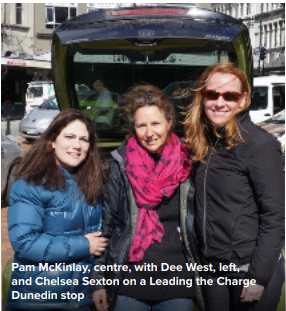
Pam McKinlay is a driving force behind the Dunedin EV Owners’ Group and organises events for Drive Electric Week and the Leading the Charge EV road trip annually.
She loves “sharing the EV grin” and seeing the reaction of first-time EV drivers, while also helping with EV “myth busting”.
“Many questions are the wrong ones,” she says.
”For example – how long do the batteries last? A lot of people have a mindset about AA batteries that you throw out when they go flat. I start by getting people to ask a question that makes sense for me to answer. Regarding range – range is what it is and you pay for what you get. Price point is what people will be able to afford and that will be the range they have to consider.”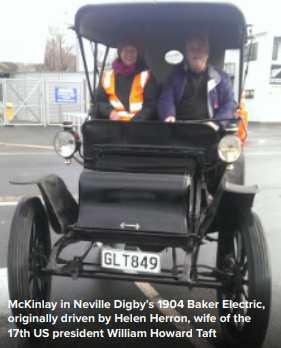
Most interactions with people are very positive as they are genuinely interested in a discussion about the pros and cons of owning an EV, she says.
McKinlay shares her EV passion with husband Tom and many other EV advocates around the country.
Her EV work includes answering many questions in person, on the phone, through Facebook and other social media, at EV owners’ meetings and anywhere else EVs are part of the transport mix.
She also enjoys meeting other people committed to positive change, such as Californian EV campaigner and regular Leading the Charge visitor Chelsea Sexton along with “EV legend” Dee West.
Support from other earlier adopters around the country, including Russel Watson and Dunedin EV Owners’ Group co-coordinator Alan Wilden are among her highlights too.
Following the first annual EV road trip from Cape Reinga to Bluff in early 2015, organised by the Better NZ Trust and originally arranged by trustees Carl Barlev, Steve West and friends to prove EVs could handle long distances.
McKinlay and friends drove out to meet the second Leading the Charge road trip in April 2016 and she helped arrange video coverage.
“Climate change was the factor that spurred us to commit to buying an EV,” McKinlay says.
“Transport was the biggest chunk of our household emissions.
“We needed to know if EVs would work for a busy family and to show people that if we could do it, then other people in our situation could do it also.”
McKinlay says the EV switch was a leap of faith.
“We had heard about electric vehicles from overseas reports.
We got into EVs in 2015.
Auto Court had an EV in their showroom for a while and we went and had a look and hummed and harred as most people do over a major purchase, and did the EV101 research on range anxiety and all the rest of the usual EV questions.
“Then we looked at doing an EV conversion through the Valley Community Workspace but decided to go with a second-hand off the shelf number.
At that time there weren’t really any dealers with EVs on the floor except a lines company in Alexandra which had started EV Imports.
“So that’s where we headed to try one out and left with an order for one.”
The McKinlays have a 24kWh Nissan Leaf which three people in the family drive, saving about $3600 annually in fuel as it’s their only car.
Nearly all their EV charging is done at home, usually overnight.
Sometimes the family uses ChargeNet NZ fast chargers when out and about, especially on longer trips out of town or between the airport.
The cost of EV charging at home is around $12 a week, McKinlay says.
Rapid charging costs can vary from $14 a month to $114 per month, depending on the trips.
McKinlay has since been involved in organising major Dunedin area events for Drive Electric Week; the Dunedin pit stop for the Leading the Charge road trip; Tech Week; NZ Science Festival; and smaller local events.
She often points enquirers toward resources held by the Better NZ Trust, the Energy Efficiency and Conservation Authority (EECA) and others.
To counter an occasional intractable view that EVs are rubbish – which McKinlay says is based on misinformation – she often takes a 40c petrol discount voucher out of her purse and offers it to the sceptic, adding: “I haven’t got any use for this, would you like it?”
“The light flicks in their eye as they struggle with the desire for that voucher and the idea that to accept the voucher is a form of concession in the discussion.”
McKinlay says many people say their next car will be an EV.
“I think we will see EV car sharing, and nearly all remaining private cars being powered by BEV or PHEV.”

Join the conversation