
E-bus plans explained
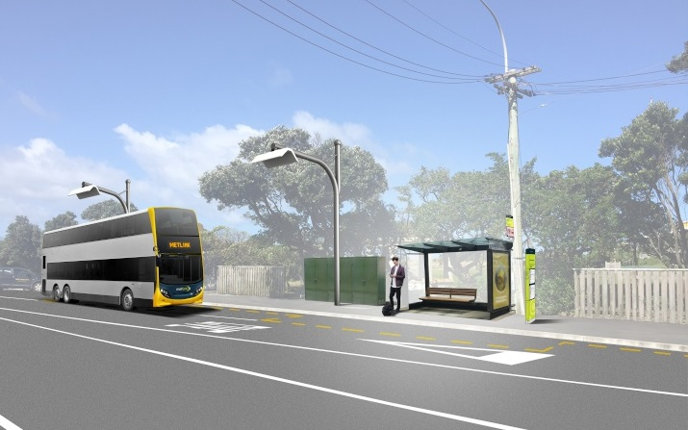
Infrastructure plans to help power the country’s first fleet of battery-powered buses were revealed to Island Bay residents in Wellington on October 2.
The Greater Wellington Regional Council proposes installing two charging poles in Reef Street, where buses currently terminate, to provide fast top-ups for 10 electric double-deckers that will operate between Island Bay and Johnsonville from July.
The Island Bay Residents’ Association heard from council staff about details of the new technology, along with artist impressions of how the street will look with the poles in place.
Bus operator Tranzit lodged a resource consent application last month with the Wellington City Council to install the charging poles.
Greater Wellington will lodge an application this month seeking formal recognition of the bus stops next to the poles.
The stop beside one of the poles will be formally gazetted as a layby, where buses can take as long as they need to recharge – probably about 10 minutes – while the other will be a regular stop. Buses there will be able to recharge in the time available before their scheduled departure.
The Island Bay infrastructure will help towards the goal of an all-electric fleet, Greater Wellington’s sustainable transport committee chairwoman Barbara Donaldson says.
“Electric buses will only grow as a proportion of the overall regional fleet, providing a reliable, emission-free form of public transport.
“In effect, they will become the trolley buses we are about to retire – but with a far wider area of operation and without the limitations and high maintenance of overhead wires.”
Another 22 electric buses will come into service during the next three years. In 2020, 10 will be added to the Island Bay-Johnsonville route, and 12 will begin operating on the Brooklyn-CBD route in 2021.
Wellington’s much-loved trolley buses end their service in about three weeks after more than 60 years.
In 2014, the council voted to stop funding them as part of a plan to modernise the region’s bus fleet.
New diesel and electric buses begin service mid next year.



Join the conversation