
Electric vehicle for wheelchair users
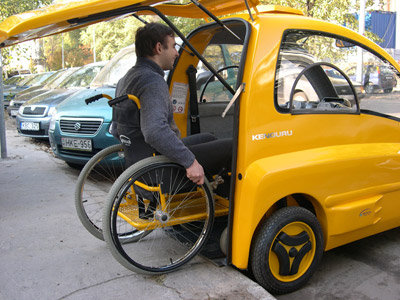
The Kenguru is an electric vehicle now available for people in wheelchairs.
Originally developed in Hungary, the Kenguru is hand built in Texas because wheelchair user and Austin attorney Stacy Zoern, born with spinal muscular atrophy, could not find a car to use, international media reports.
While a student at the University of Texas, Zoern had previously driven a modified van which was damaged in a crash and no longer safe to drive,
She was doing some online research on transportation about six years ago when she came across Kenguru (Hungarian for kangaroo) prototypes.
A Budapest-based company was advertising small electric vehicles that allowed wheelchair users to enter through a back hatch and drive – never getting out of the chair.
“It basically extends the range of a wheelchair,” Zoern says. “I can go maybe a mile in my chair out in the elements. Now I can go 20 miles (32 kilometres) and be protected from the rain and the sun,” she says. “It’s not a car — it’s an expansion of your independence.”
At the time the company was struggling, so Zoern offered to help. After discussions with owner Istvan Kissaroslaki, the company was moved to the US and set up as Community Cars with Zoern and her partners raising around US$3 million (NZ$4.2m) to keep the fledgling company alive.
“We never had money in the bank,” Zoern says. “But we always had enough to take the next step forward.”
The car, which costs about NZ$29,000, is 2.13-metres long, 1.5m high and can be charged at home. It has a top speed of 40kmh with a range of about 100km.
Zoern’s goal is to produce about 4000 Kengurus annually.


Join the conversation