
EV growth provides opportunities
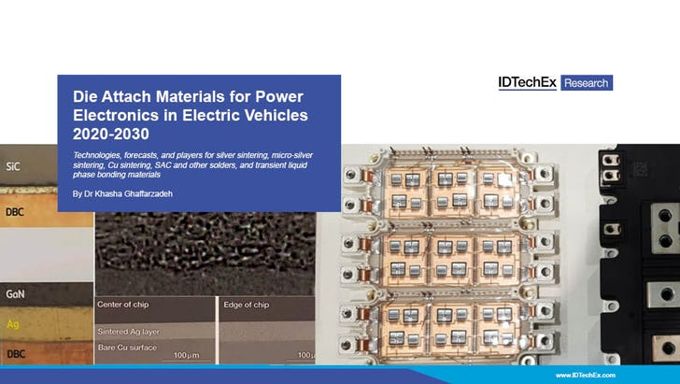
The rise of EVs is creating many new material opportunities.
That’s according to IDTechEx research director Dr Khasha Ghaffarzadeh who says one such is the die attach material used in power electronics.
The trend towards higher power densities and thus higher operating temperatures is opening up the market to new non-solder solution despite the substantially higher costs of the alternatives, he says. The IDTechEx report Die Attach Materials for Power Electronics in Electric Vehicles 2020-2030
finds that metal sintering including all Ag and Cu types will become a US$30 million market by 2026 in EV power electronics.
In an EV, power electronics fulfil various functions including on-board charger, various HV-LV DC-DC converters, and the main traction motor inverter.
The performance requirements across these functions differ. Yet, some common technology trends cut across all of them. In particular, the operating temperature and frequency of power electronics is rising with profound consequences across device and material technology development and choices. The emerging generational shift towards SiC MOSFETs and GaN HEMTs partially underpins and certainly accelerates these long-term trends.

Market forecasts are provided for EVs across more than 100 categories covering all types of vehicles in land, air, and sea.
Many materials will be pushed beyond their performance limits, opening up opportunities for new arrangements and materials.
Die and substrate attach technologies will change with a rise in operating temperature as well as the need to prolong product lifetime under even harsher thermal cycles.
Metal sintering has been in development mode for more than a decade and is already commercialised in applications such as renewables and also in leading EVs.
Here, metal particles are sintered with or without pressure to form a near solid-like thin film, offering high joint shear strength, high thermal conductivity and a very high bulk-like melting temperature resulting in a high homologous temperature.
IDTechEx find this to be an exciting market, and suppliers who pioneered the development are now reaping the benefits.
Visit www.IDTechEx.com/DAMats or email Research@IDTechEx.com for more information.

Join the conversation