
Faster charging – is the network up to it?
As the drive towards more electric vehicles speeds up, questions are being asked whether the infrastructure for them can cope.
That particularly applies to EV charging, with the ABB Technology Summit in Auckland on June 6 highlighting that smart charging and renewable energy will help.
Increasing digitalisation and connectivity, partnerships between the various businesses involved, and newer and faster developing technology will all contribute.

EV chargers are already capable of delivering 200km of range in eight minutes – similar to the time taken to fill a conventional fuel tank, ABB’s Chris Thomas explained to more than 80 people at a session on the next evolution of EV charging.
Thomas says ABB has a charging station for all occasions, ranging from an AC wallbox delivering 3-22KW in four to 26 hours, a DC wallbox providing 20-25kW in one to three hours, a ABB Terra 50kW fast charger to a DC high-power station providing 150-350kW in 10-20 minutes. Many of the latter are being introduced to the US and through the Ionity network to Europe and the stations are easily transportable.

The first ABB high-powered charger is on order and due to be commissioned in New Zealand “in the next few months”, Thomas says.
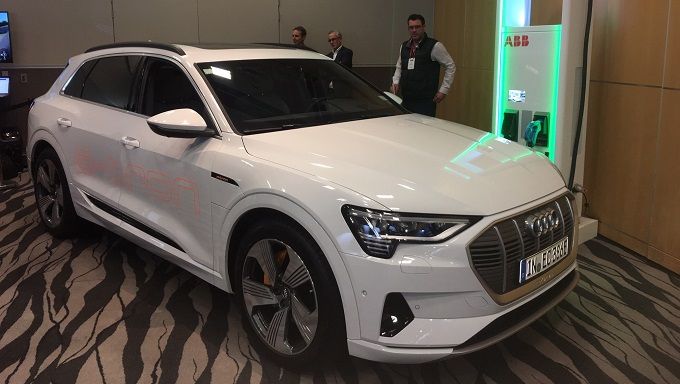
As an example, the summit hosted a first glimpse of the new Audi e-tron SUV hooked up to a demo of a new High Power ABB charger – which supports CCS (500A liquid-cooled cables) and Chademo (200A) as well as being a modular system, with charging power available from 175kW up to 350kW.
“EVs must be more affordable and grids must be restructured,” he says, illustrating how new power grids can incorporate renewable energy such as solar and use smart technology to deliver power at suitable times to avoid overloading.
He expects EVs to achieve price parity with internal combustion engine (ICE) vehicles by 2025 and take off.
“We’re almost there – time is seriously running out.”
Outlining ABB’s charging solutions, Thomas says converters and chargers are integrated so all charging requirements are on the portable stations which can be delivered by truck to the required site.
“These are standardised units able to be delivered anywhere in the world today.
“They have everything you need for charging.”
ABB NZ managing director Ewan Morris says the summit covered digitalisation including ABB Ability digital solutions for smart charging to deliver power to EVs through intelligent chargers to avoid power overloading.
That’s possible when EVs dominate globally, putting huge demand on power resources – likened by some at the event to a “boiling ocean” effect.
The main message was around digitalisation, Morris says, the summit covering digital solutions for industry including cloud solutions, security, 5G and more.
Partnerships between business are essential too, much like those being established between various automotive manufacturers for EV production.
“There needs to be partnerships to be successful, particularly around digital solutions as the technologies are many and varied,” Morris says.
Energy optimisation and many other aspects around EVs are giving rise to huge value creation opportunities in the business-to-business space, he believes.
New business models will come, and Morris sees the increasing popularity of car sharing incorporating EVs and wider use of autonomy and robotics as having an impact on society too.

Join the conversation