
First VW ID.3 off production line
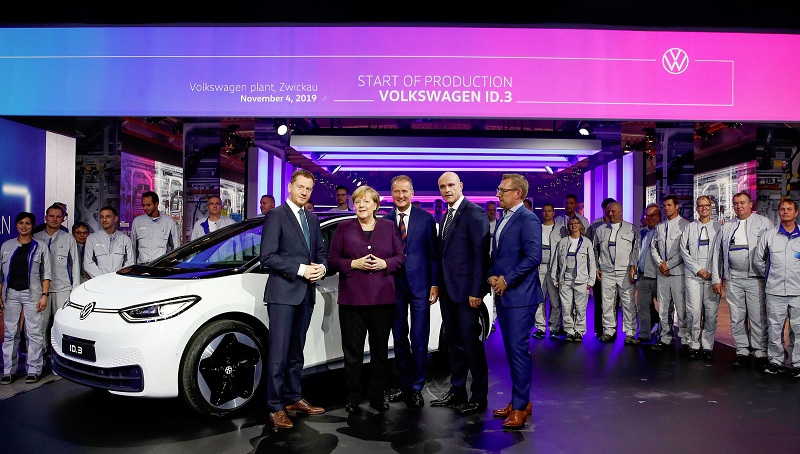
Volkswagen is speeding up its global electric offensive with the start of ID.3 series production.
The first car in the new generation of EVs – a white ID.3 – rolled off the assembly line watched by Germany’s federal chancellor Dr Angela Merkel and VW Group chief executive officer Dr Herbert Diess.
The group plans to sell about 22 million EVs worldwide by 2028.
VW’s Zwickau factory is being converted to e-mobility through a 1.2 billion euros investment and is scheduled to produce about 100,000 electric models next year.
From 2021, up to 330,000 EVs will leave the assembly line annually.
“The ID.3 will make an important contribution to the breakthrough of e-mobility,” Diess says.
“It makes clean individual mobility accessible to millions of people and is a milestone for our company on the road to becoming climate-neutral by 2050.”
The basic ID.3 version is priced at under 30,000 euros in Germany and will be launched almost simultaneously on markets throughout Europe in mid-2020.
More than 35,000 international customers have reserved an ID.3 and paid a pre-booking deposit.
Production is carbon-neutral, which means the car is delivered to customers with a carbon-neutral footprint.
Green power is exclusively used in energy-intensive battery cell production for the ID.3, for example. Emissions from the entire production process that are currently unavoidable are offset, among other things through investments in the “Katingan Mataya Forest Protection” climate project on the Indonesian island of Borneo.
In the final expansion stage from 2021, six electric models from three of the group’s brands will be built in Zwickau.
“The ID.3 is a high-tech car from a high-tech factory,” VW e-mobility rand board member Thomas Ulbrich says.
“With some 1700 robots, driverless transport systems and fully-automated manufacturing processes, Zwickau gives a contemporary insight into the shape of forward-looking high-volume production of EVs.”
The VW group is also cooperating with Northvolt to set up a major battery cell factory in Salzgitter.
Meanwhile, Germany is also increasing purchasing incentives for EVs under 60,000 euros – extending the incentive scheme to 2025 – and its government plans to put 3.5 billion euros towards EV charging stations.
VW Group Australia is prepared for the introduction of its EVs there, with the group’s EV project head Kurt McGuiness deputy chair of the Electric Vehicle Council Australia.

Join the conversation