
Has electric gone Audi?
Audi New Zealand has pulled the local covers off its first battery electric model and made the bold claim: Electric has gone Audi.
OK, so there is a little marketing bluster in there, but as far as the New Zealand market goes, the brand does have a little bit of a claim to doing electric to the extent that only Tesla has done before, and in some areas beyond.
Two months ahead of launch it has landed four left-hand drive models into the country and registered them for road use – they actually showed up in May’s used car registrations.
They are travelling the country for charger verification and testing and will go on show and be available for test drives around the country.
You can call your local Audi dealer if you want a look, though if you’re going to buy, the first 100 units destined to arrive this year are already spoken for.
Audi will be selling the car at all of its dealerships, and they will all have DC fast charging, some set to outstrip the current local standard with the fitment of 175kW ABB units.
Selling and servicing at every dealership comes at a significant cost to the brand, with 40 technicians already coming to Auckland for high-voltage vehicle training.
Audi’s focus on charging will extend into customers homes, with a partnership with Vector and its HRV subsidiary.
HRV will provide home energy assessments as to how much power is fed into the house, and subsequently, how much charging can be provided.
More on that later.
The first of Audi’s BEVs to arrive is the e-tron, a medium-to-large SUV that retails from $148,500 for the 55 Quattro model, and $157,000 for the advanced model.
It comfortably seats five and is sized at slightly smaller than the seven-seat Q7, around the same as the Q8.
Built in Belgium, it shares a platform with those fossil-fuelled models, though being modular, Audi has done an excellent job of laying out the battery in a way that does not impinge on the spacious interior.
The battery is 95kWh and actively cooled.
Charging is CCS Combo type 2, with DC fast charging at up to 150kW, and AC charging at up to 11kW.
Audi New Zealand general manager Dean Sheed tells EVtalk 22kW may come next year in combination with a vehicle-to-home unit that can be packaged with the car.
The two electric motors – one front, one rear, give a combined 300kW of power and a beastly 660Nm of torque.
Performance from 0-100km/h is rated at 5.7-seconds per 100km.
Audi is keen to push that the e-tron is ready for Kiwi life.
An optional tow bar gives the ability to pull up to 1.8-tonnes, which is not enough for a substantial boat or caravan, but suitable for most uses.
Roof rails, roof boxes and cycle racks can all be fitted as options.
“Performance means something different in New Zealand, and here at Audi we repositioned performance in NZ terms,” Sheed explains.
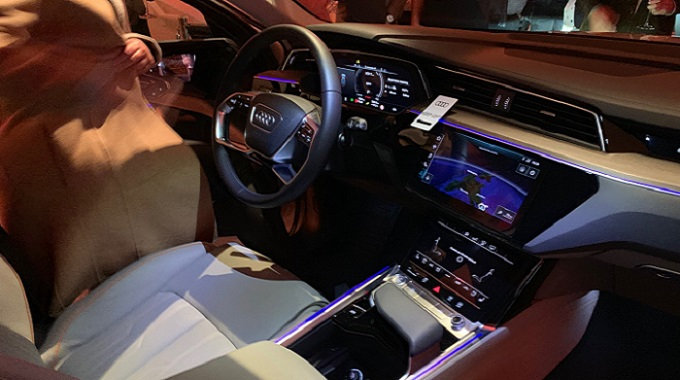
The e-tron counter’s Tesla’s massive screen with the brand’s virtual cockpit system.
The driver gets a screen in front of them, one atop the centre console where you would typically expect one, and a screen below this.
The driver interacts with the variable drive systems and regen systems through the main screen using an ‘efficiency assist’ system.
In combination with the adaptive cruise assist, the efficiency assist can also brake and accelerate the Audi e-tron predictively.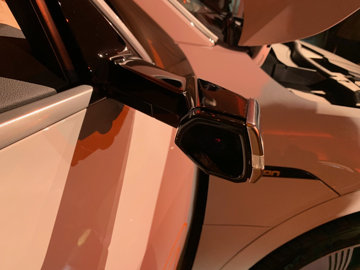
The infotainment system included an embedded sim for the Audi Connect system, allowing for live services and 3D Google mapping.
On top of the assist systems is the central driver assistance controller, which continuously computes an exact model of the environment.
The required data is obtained “ depending on the selected options “ from up to five radar sensors, six cameras, 12 ultrasound sensors and the laser scanner.
A unique option – unique to the point that the NZ Transport Agency has had to give Audi an exemption for the tech – is the optional virtual exterior mirrors.
Integrated into each of the mirror supports is a small camera, whose images are displayed on high-contrast OLED displays inside the vehicle.
Removing the mirrors gives a 35km gain in range, thanks to the lower windage of the camera mounts.
The mirrors come as part of a $5800 tech package on the Advanced model only.
The differences between the standard and advanced models are relatively minor.
The Advanced gains 20-inch wheels over 19-inch units, extra rear side airbags, 360-degree camera, a heads up display, upgraded front armrest and higher quality leather.
S-Line, Luxury and the aforementioned technology and comfort packages can only be added to the Advanced.
Just the start
Sheed says the e-tron is just the start of Audi’s electric fleet – not that it is a cold start, with the A3 and Q7 e-tron plug-in hybrids having been on sale for a few years already.
Sheed, prominent for his work with Drive Electric, is one of the most EV-passionate members of the new vehicle trade.
The brand will have 30 electrified models on sale by 2025, 12 of those full BEVs.
Four will be on the road by 2021, and you can expect most will come here.
“We are almost beyond this car, planning what is coming over the next four years,” Sheed says.
“What is next? An S version of the e-tron will be here in six to nine months, a Sportback around the same time, and after that the e-tron GT – a platform mate to the Porsche Taycan.
We’ve got SUV’s, we’ve got sports cars, we’ve got all the stuff you would expect.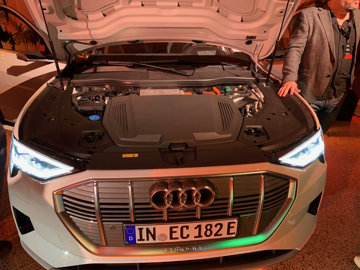
Our theory is the vehicle brought to you by Audi happens to be available as electric.
The hard work marketing Audi’s electric efforts and planning have already been rewarded, with the first allocation sold out in just a few days.
“We sold a year’s supply in eight days.
It is kind of a good problem to have, but not good at the same time.”
Sheed explains the brand decided to work with ABB and dealers – who are footing most of the bill – to put DC charging in because as the volume of vehicles grows, fast charging will be required to keep up with demand from cars coming in for service.
It could be that those chargers are opened up to customer use, but that will be on a case by case basis.
The units are ready for it.
“We have spec’d our chargers with an RFID reader, EFTPOS and 3G.
Now if a dealership chooses to put one of those in a very popular location.
For most out-of-home charging, e-tron owners will have access to the ChargeNet NZ network.
Chargers were tested and adapted to ensure they work, while all owners will get a ChargeNet fob built into their Audi key-ring.
It’s an Audi
So what is the e-tron like? EVtalk got to check it out, and take it for a very short drive at the brand’s reveal and launch event in Auckland recently.
First off, don’t expect some crazy spaceship-like electric concept.
The e-tron fits very nicely between its conventional cousins.
Yes, it is modern with its sharp lines and blacked-out glass, but it looks like the crossing of an Audi Q7 and Audi Q8 “ which makes sense.
That appearance similarly applies unless the option of the camera-based rear-vision mirrors is ticked.
It takes a moment to get used to the look of a vehicle with only stubby stalks where mirrors usually would be.
From the driver’s seat, the system will likely take a little getting used to as well, the mirror image displayed on screens in the door of the car, just below the front corner of the window.
The interior itself is fabulous.
The virtual cockpit screens are all canted towards the driver and in easy reach.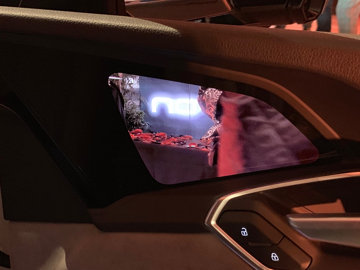
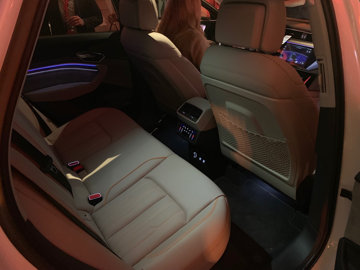
The front seats are large and comfortable, while the rear seats are very spacious “ more so than the Mercedes-Benz EQC.
Even with the optional panoramic sunroof, headroom is excellent.
Knee space for the centre rear passenger is right due to the position of the climate controls.
The boot, at 660 litres with the seats up, is proper Kiwi-family size.
Behind the wheel, there is a slight learning curve over the standard model, with a unique transmission shifter “ the main shifter is rigid, and you select Drive by pushing its centre-right section forward and back.
Pulling away in the e-tron is quiet and smooth.
The length of the drive means we can’t give you too much insight into how it handles, but we can see the steering is light and has a nice feel to it, the ride is excellent on imperfect city roads, and that the Audi is quiet – very quiet.
A blast away from the lights proved performance-wise the Audi is no Tesla, but arguably it does not need to be, and will likely still beat most SUVs off the mark.
I would hazard a guess that despite the deficiency in power over a Model S or X, in real-world conditions, particularly on more dynamic roads, the e-tron will not be left behind.
The Efficiency Assist system has a range of automatic and manual models that maximise range through reducing response or beefing up regenerative braking.
Regen can also be boosted using steering-wheel-mounted paddles.
Audi claims the car can generate up to 220kW of energy when regening, and claim if you are coming down a steep hill, you can gain one km of range for every km travelled.
Our drive in the e-tron was impressive but all too short.
We will get to drive the car properly “ and in right-hand drive rather than left-hand drive “ in late July.
Keep an eye on EVtalk.co.nz for that report.

Join the conversation