
How roads will look by 2050
In 30 years a lot of new technology will be on our roads, improving daily commutes and the environment too.
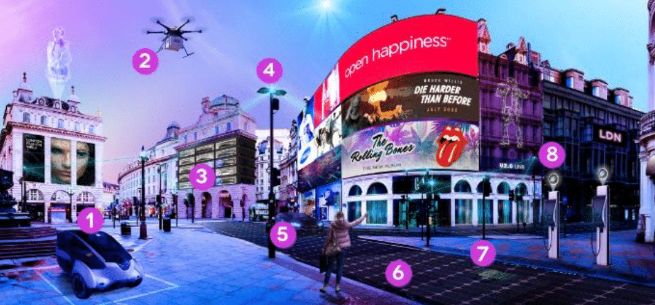
Car leasing service Leasing Options has pulled all technologies being developed today into one scene to show how roads may look by 2050, using London’s iconic Piccadilly Circus as an example.
Companies are creating new modes of transportation to get commuters from mass-transit stations to their final destinations.
Electric micro-vehicles will be kept at “last-kilometre stations” (1) and will protect users from the elements, not requiring a driving licence to operate.
VeloMetro is working on this technology and has already publicly launched a pilot fleet serving University of British Columbia students and staff.
Its Veemo is the first one-way sharing network of three-wheeled, electric-assisted vehicles in the world, and the company hopes to expand to the Vancouver urban core soon.
Large delivery companies such as Amazon and UPS are already working on delivering packages via drones (2), expected to dramatically reduce trucks on the road. Amazon has set-up Prime Air, a service that delivers packages up to 2.2kg in 30 minutes or less.
Companies like Zipline deliver vaccines and other medical supplies using more plane-like drones.
A shift from private to shared autonomous vehicles (AVs) could reduce parking demands by 50%, but to do this shared vehicles (3) will require special parking facilities with electric charging stations and vehicle cleaning services, the Victoria Transport Policy Institute says.
AVs are unlikely to return home, owners expected to want their vehicle nearby, again resulting in somewhere to house them.
Sensors (4) will be in everything, everywhere.
They’ll be embedded in vehicles, buildings, traffic lights and roads, which will provide real-time traffic flow and usage patterns, preventing accidents. Analysts predict there’ll be more than 21 billion things connected by sensors by 2050.
Transportation will go from fixed routes and timed schedules, to one where the number of trains, buses, ferries and more available will depend on user demand due to connected devices and Big Data (5).
That could improve operational efficiency and reduce waiting times and crowding at peak times. Trials of the new on-demand system including Arrivaclick from one of the UK’s leading bus companies Arriva in Leicester, Liverpool and Watford.
Pickmeup in Oxford from Oxford Bus Company and Slide in Bristol are among others.
These services allow customers to tell the companies where they want to be picked up via an app. Riders then pick customers up from ‘virtual bus stops’ the intelligent software works out the best way to take riders and other passengers to chosen destinations.
Companies are testing solar panel roads (6) to generate energy for power grids or to charge EVs while driving.
They will also likely power road-side signs, speed cameras and streetlights.
Some experts believe if roads are converted from tarmac to solar panels enough sunlight could be absorbed to power entire cities.
Israeli start-up Electreon specialises in enabling EVs to be charged while on the road. Its goal is to initially electrify urban bus and shuttle routes to clean Israel’s city air and reduce the country’s dependence on oil.
Self-repairing or “self-healing” roads (7) are being studied by researchers at Cambridge, Bath and Cardiff Universities.
A material can be applied to roads, eliminating potholes and cracks. Today’s roads have a 20-40-year lifespan but this new technology could see that doubled to 80 years.
Epion Asphalt has healing technologies extending pavement service life by 50-100%.
EV use could reduce carbon pollution by 550 million tonnes annually by 2050.
That’s the equivalent to the emissions from 100 million of today’s passenger cars, says a study from the US-based Natural Resource Defense Council and the Electric Power Research Institute.
As a result, EV charging points (8) will be more widespread.

Join the conversation