
India set to take over e-bus market
 The Chinese market for electric buses has sharply dropped as subsidies disappear.
Meanwhile, India has announced energetic moves to replace 150,000 diesel buses.
That and more modest moves elsewhere are likely to keep e-bus deliveries rising, according to analysts IDTechEx in the report Electric Buses 2019 – 2029.
“We have tracked this market for 20 years, so we have good insights and inputs,” says lead author Dr Peter Harrop, who is also IDTtechEX chairman.
“However, things are moving so fast now that we have completely rewritten this years’ edition. For example, we get behind why there are now large supercapacitor buses in seven countries. Aside from regional and supplier aspects of many categories of electric bus, we assess the impact of fuel cells, new power electronics, more motors per vehicle, autonomy, energy harvesting and energy storage bodywork and new charging options, such as at speed on the new solar roads.”
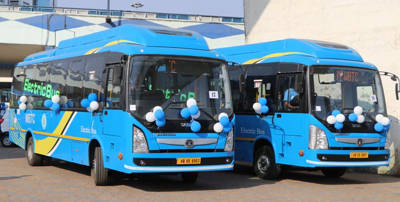
With excellent bus designs, Tata Motors is now participating in tender bids for all state transport corporations in India and others are also active.
Tata Motors will finish the delivery of 255 electric buses to six states within three months. The company took the contracts from the state transport corporations (STCs) under the FAME I scheme.
One order includes 80 buses from Bengal, 40 each from Jammu and Kashmir, Lucknow, Indore and Jaipur and 15 from Assam. Under the FAME (Faster Adoption and Manufacture of Hybrid and Electric Vehicles) scheme, 60% of the bus price is contributed by the centre while the rest is provided by the states. Contrast that with China’s zero subsidy next year.
Besides supplying the buses, Tata is providing charging stations at bus depots with each station.
“With a full load and AC in full blast, one full charge will have a range of 150km,” says Rohit Srivastava, Tata Motors product line head of passenger commercial vehicles, who was in Calcutta for the handover of the buses.
“The range also depends on the traffic conditions and how the buses are driven,” he adds.
The 120kW battery will be fully charged in 2.5 hours. The company is also providing facilities for intermediate charging, which will take 30 minutes to top-up.
“There is a spectrum of choice extending to Swiss ABB doing partial top up and supercapacitor buses doing full charge both in 10 seconds, but more points are needed along the route,” Harrop says.
“Business cases are improving at different rates and coming from left field is the very different option of a swarm of multi-tasking robot shuttles.”
Asked if the FAME II incentives will encourage battery manufacture in the country, Srivastava says, “Energy storage is an imperative for the industry but it will depend on the explosion of usage of electric vehicles”.
IDTechEx forecasts this in a new report Energy Storage for Electric Buses and Trucks 2019-2029.
Some findings are that such energy storage, already a big business, will rapidly drop in value share of a bus or truck’s overall cost but still see strong overall market growth. Of the two, truck energy storage will rapidly become by far the biggest storage market.
Contact research@IDTechEx.com
for more information.

Join the conversation