
Kia Niro adds space to successful EV SUV recipe

Last year Hyundai made a lot of noise about the launch of the Kona Electric SUV, and rightly so.
It is one of the best electric vehicles available on the New Zealand market, and has been a relative hot seller.
Kia on the other hand has been a little more reluctant to shout from the rooftops about its first full electric effort, the Niro EV, in spite of the fact it shares a lot of elements with the Hyundai.
It has been on sale here for a few months now, but review units are only just starting to go out and marketing has been incredibly muted.
That could be that they are in relatively short supply – EVtalk understands a limited number were initially secured by Kia New Zealand.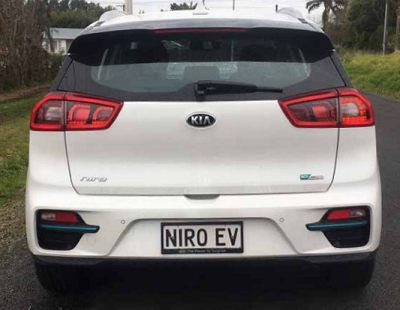
There is definitely an argument that there is no point in spending marketing bucks on a car, then have to say no to prospective buyers because it is in too high demand.
While New Zealand seems to be getting a solid share for EV production, that can still be small numbers considering how hard some are finding it to secure battery supply.
Kia is offering two versions of the Niro EV, both largely the same save for the battery size and motor power.
The EX 289 costs $69,990 and features a 39.2kWh battery, the motor puts out 100kW and 395Nm of torque, and goes, well 289km (WLTP).
The EX 455 – you guessed it, the range is 455km – gets 150kW from its motor and features a 64kWh battery for just $6000 more.Both batteries are actively cooled.
Why anyone would consider the 289 is beyond me – 24kWh extra capacity for $6000 is a bargain.Plus, the 289 is some $10,000 more expensive than a 40kWh Leaf, and $20,000 more expensive than the launch price of the MG ZSEV.
The 455 though is more on the money.It sits between the two Kona models on price and spec, and the battery size gain makes it a worthwhile price step over the likes of the Leaf and Ioniq.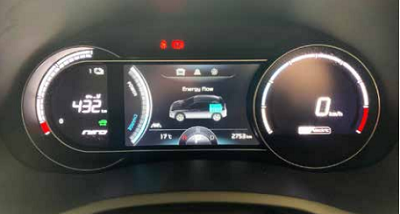
The trickier question is why you would shell out $2-$3000 more than the price of a Model 3 Standard Range Plus? Some will prefer the backing of a nationwide dealer network, the SUV shape and others may just not be willing to jump on the Tesla hype machine yet.
For fleets, who want a vehicle that has zero learning curve over their other vehicles, the Niro is likely to appeal as well.
Over the hybrid versions of the model the key differences are the now closed grille, which houses the CCS2 charging port, a revised centre console with a rotary-dial style shifter, paddles to vary regeneration attached to the wheel and a slightly revised LED dash screen.
The Niro is not going to win any beauty contests, although it is attractive enough.
The shape is SUV-ish, though it could be argued it is a large hatchback or a small wagon.
The front has a hint of Soul (the other Kia EV) to it, while the rear just feels a little dated.
There are some cool details, like the plug motif on the charging lid, and arrow-like driving lights.
The centre console may seem a little detail, but it is one of the areas that splits the Kona and Niro apart.
I very much prefer Kia’s dial for changing gear to Hyundai’s buttons, but the centre console does feel a bit “tacked on”, rather than the full, raised centre console in the Kona that adds a real premium feel to that vehicle.
The interior is otherwise a very nice place to be, with excellent build quality and finishes, and it is roomy both front and rear.
The touchscreen infotainment system is easy to use and features Apple CarPlay and Android Auto.
The seats are part synthetic leather and very comfortable – though not heated.
A chat to a Kia spokesperson suggested that with the amount of range on offer, the argument over heated seats being more efficient was not really necessary.
The cabin warmer/cooler is an efficient heatpump.
What you get in spades over the competition is interior space.
The Kia is 200mm longer overall, 100mm of that in the wheelbase.
That makes it roomier by pretty much any measure, and gives it nearly 120 litres of extra boot space.
The rear seats fold down – families and commercial users will both find this the more practical option.
It drives pretty well too.
The Eco and Sport modes vary the amount for power available, and regeneration levels, or you can do that manually via the steering wheel paddles.
In Sport mode the full 150kW and 395Nm are on offer, and it can scurry away from the line in haste.
The ride is comfortable, the steering is light and responsive, and the Niro feels very stable through corners.
We did find in the wet, however, the eco-biased tyres felt a little underwhelming – not unsafe, but just lacking in a little bite.
Eco mode drops the maximum speed of the vehicle down to 90km/h and reduces torque and response.
It is a great way to be able to boost range without having to think too much about it.
You get a full range of driver assistance features as well, including radar cruise control, a lane keeping system, blind spot detection, autonomous emergency braking and a rear vision camera with guidelines.
Electronic stability control and seven airbags add to the safety equipment schedule.
How is range? We didn’t have the ability to do a full range test on the Niro, though found it easily passed 300km before we felt the need to plug in – with range to spare.
We like nose-mounted charging ports, as in the Niro, as they work with almost every charger we have come across without the need to park across lines.
We did one large charge during our drive, an hour on an ABB 50kW unit to get to 80%, taking on 43.363kWh.
The onboard AC charger is a 7.2kW unit, and we must commend Kia for providing not only a portable charging unit, but also a type-2 to type-2 cable, adding around $500 extra value to the package on that one cable alone.
Charging times are going to depend on your personal setup, although with this level of range it is safe to say that in normal use you do not need to plug in often.
Kia has backed the Niro EV with a solid warranty programme.
The battery is covered by a seven-year, 160,000km policy, while the whole vehicle is covered for five years or 100,000km.
For its first official BEV effort in the New Zealand market, the Kia Niro is well packaged and very easy to live with.
Model 3 aside, it is competitively priced in 455 form, and its added practicality may just give it a slight edge over its Korean EV SUV cousin.

Join the conversation