
Kiwi car love pushes up emissions
New Zealand household greenhouse gas emissions are up about 19% in the decade ending 2017, mainly because of Kiwis’ fondness for vehicles.
Newly released Statistics New Zealand figures show households accounted for 11% of total emissions in 2017 compared with 9% in 2007.
“Household emissions are going up because New Zealanders love cars and that leads to emissions,” senior analyst Adam Tipper told Radio New Zealand (RNZ), adding that New Zealand is going against international trends.
“We do know that people love to go away in their cars for domestic tourism, as well as commuting.”
The report could spur interest in electric vehicles to help reduce household emissions.
Vehicle emissions increased partly because of the greater number of tourists on the road.
“Emissions from road transport have also been increasing due to the higher number of tourists using road transport,” the Stats NZ executive summary says.
Road transport emissions from international tourists in New Zealand rose 19.3% over 2007–2017, amounting to 7.8% of total road transport emissions in 2017.
Tourists use mainly diesel which has a higher emissions factor than petrol, and a higher relative contribution to emissions per dollar spent, the summary says.
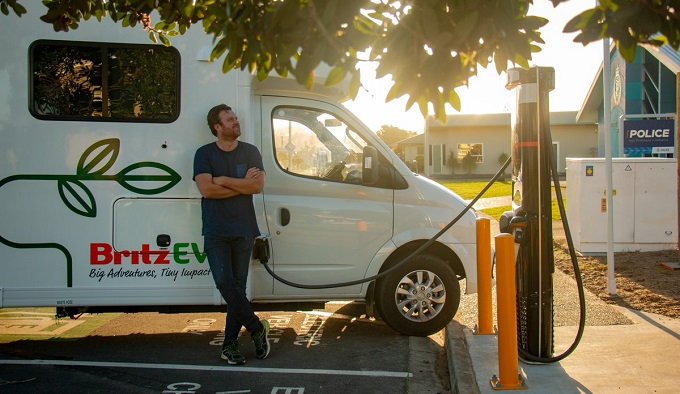
Rental companies catering for tourists like Jucy and THL are introducing electric camper vehicles.
Total emissions from international tourists increased 20% over the period. The emissions intensity of tourism (emissions in relation to tourists’ average length of stay) also increased over that time.
Household emissions rose 19.3% from 2007–2017, mainly due to road transport.
“Compared with industry emissions, household emissions increased at a faster rate as reflected in its contribution to total emissions, which rose from 9% to 11% over the period,” Stats NZ says.
“This increase was faster than the increase in the number of households (up 9.7% over the period), which implies that households have been less efficient at managing direct emissions since 2007.”
Industrial emissions fell 2.9%, attributed mainly to increasing use of renewable energy like wind and geothermal.
Environmental-economic accounts: 2019 (data to 2017) showed New Zealand was one of a small number of developed nations to see household emissions increase over the 2008-2015 period.
This increase was faster than the increase in the number of households (up 9.7 percent over the period), which implies that households have been less efficient at managing direct emissions since 2007, Stats NZ says.
New Zealand is one of 10 (out of 38) countries that has seen production of emissions by households increase since 2008–2015.
The report notes that many significant changes in New Zealand’s climate have already been observed across the country, along with regional variations, and that effects will intensity.
Changes include alterations to temperature, precipitation patterns, sea-level rise, glacier ice storage, wind and sunshine, and ocean acidification.
New Zealand’s annual average temperature increased 1 degree Celsius between 1909 and 2016. Four of the last six years were among the warmest on record.


Join the conversation (1)
The myth that new Zealanders love cars is really sad. There’s lack of any credible alternative to cars for a vast majority or people in nz, so they have to drive even if they don’t have to.
If someone broke their leg and the only way to move for them was to us crutches, would you say : ” no surprise he loves crutches, he uses them all the time” 🙂 ?