
Labour announces climate manifesto
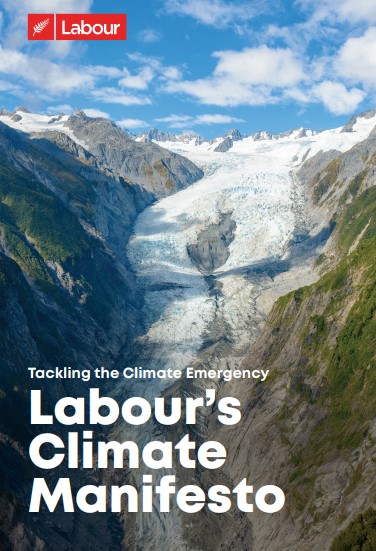
Labour’s “climate manifesto” commits to a second Emissions Reduction Plan, establishing a Minister for Just Transitions to oversee New Zealand’s transition to a low emissions economy, and provides a 12-point plan to increase renewable electricity generation.
It also supports growth of NZ Green Investment Finance by investing a further $300 million (bringing Labour’s total commitment to $1 billion), makes climate change a research and development priority with an initial $50 million investment and a further $20 million to tackle challenging parts of the economy, removing diesel generators from all schools, reforming the Emissions Trading Scheme (ETS) to drive gross emissions reduction as recommended by the Climate Commission, and delivering a new climate adaptation and managed retreat framework to support local communities to plan, prevent and re-build.
“New Zealand has an incredibly positive future if we take the climate seriously with real actions to keep reducing our emissions,” says Labour leader Chris Hipkins.
He says the climate manifesto continues the Labour Government’s momentum and is “critical to successfully cut emissions further”.
Hipkins says the manifesto is on top of commitments made so far which include doubling the number of homes with solar panels though a new $4000 rebate, EV charging hubs every 150-200km on main highways, 600 to 1000 EV chargers at community facilities in smaller rural communities, an $18,000 rebate for energy efficient deep retrofit of existing homes, a $3000 rebate for households which electrify and move off gas, support for low emissions trucks to help the freight industry decarbonise, and ensuring all farms measure and manage their emissions by the start of 2025 and rewarding on-farm sequestration.
“For a long time, climate change has been seen only as a moral issue,” says Hipkins.
“It’s now much more than that – it’s a growing economic and government credibility issue.
“Our trade and tourism opportunities depend on it, as does the wellbeing of our communities.”


Join the conversation