
Mercury rises to challenge
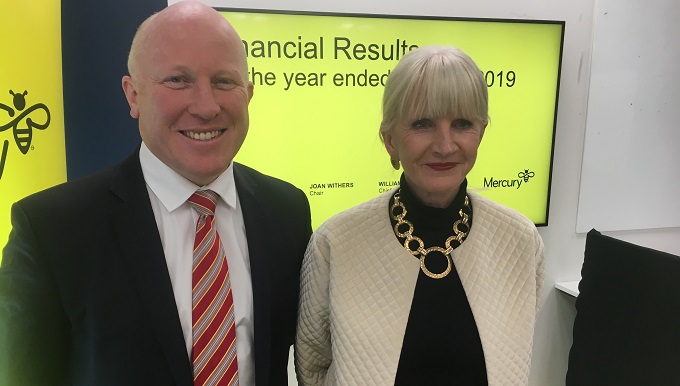
Mercury chair Joan Withers leaves her position on a high note, the company again announcing a record net profit after tax of $357 million – up 53%.
Tribute was paid to her guidance and input over 10 years by chief executive Fraser Whineray at Mercury’s financial year results briefing on August 20 which included references to electric transport and renewable energy.
Championing those two factors, Withers steps down on September 27 at Mercury’s annual shareholders’ meeting and will be succeeded as chair by Prue Flacks.
“Joan has been hugely committed as chair of the company,” Whineray says, describing her track record as “tremendous”.
Withers remains involved with various organisations such as The Warehouse Group and ANZ New Zealand as well as having philanthropic roles.
She’s looking forward to replacing her long-running Mitsubishi Outlander PHEV with a new EV but hasn’t decided what sort.
And EVs will continue to play a major role in Mercury’s future.
Whineray says solid long-term demand growth is anticipated as renewable electricity’s advantages are unlocked through technology advances in areas such as transport.
“We will continue to explore inspiring ways to encourage the transition to electrified transport for the long-term benefit of the country as well as our owners,” he says in reference to Mercury’s highly successful electric ‘Evie’ 1957 Ford Fairlane promotions.
Whineray talks about the “awesome foursome” of renewables – sun, water, steam and wind – the latter involving Mercury’s first wind farm underway at Turitea near Palmerston North.
“The great thing about renewables is that they do not require another party – just nature,” he says, pointing to a big future for Mercury in that field.
However, nature can be fickle at times. A dry spell in the Waikato catchment from September to May, for instance, impacted on Mercury’s operating earnings of $505 million, down 11% on the 2018 financial year.
Annual hydro generation of 4006gWh was in line with the company’s long-term average but was 942gWh down on last year’s record, offset by geothermal generation with a record 2896gWh.
Asked how the Government’s ‘clean car standard’ (emissions) and ‘clean car discount’ (feebate) proposals impact on Mercury and whether it made a submission by the August 20 deadline, Whineray says Mercury supports the proposals in general and is ready for the expected boost to EV uptake.
Mercury itself has converted every vehicle it can to EVs with more than 84 of Mercury’s 115 fleet now electric, including PHEVs.
Financial year highlights included the sale of Mercury’s Metrix smart metering business for $272 million, announcing major refurbishment of the Karapiro hydro station, consolidation of three Auckland premises into the one Newmarket headquarters four months ago, roll-out of a new customer IT platform (SAP Commerce Cloud) and the wind farm.
A dividend of 9.3 cents per share (cps) will be paid on September 30, bringing Mercury’s total ordinary dividend to 15.5cps – up 2.6% and the 11th consecutive year of ordinary dividend growth.
The company is now valued at $6.3 billion compared with $4.6b at the same time last year.
Mercury’s looking good for the 2020 financial year too, operating (EBITAF) guidance put at $485 million and ordinary dividend guidance at 15.8 cps (2% up).

Join the conversation