
Outlander still great – but showing age
This story first appeared in the October issue of EvTalk – CLICK HERE to download the magazine FREE
I have driven the Mitsubishi Outlander PHEV so many times now that it is almost an old friend.
And despite seven years on the market Mitsubishi continues to tweak and improve it.
And why wouldn’t they.It is already the top-selling PHEV in the market, and continues to sell in reasonable volumes.
Only the Leaf has converted more people to the electric lifestyle in New Zealand.
The latest update boosts the battery size, it is now a 13.8kWh lithium-ion unit over the old 12kWh one.
In news EVtalk should probably ignore, the 2-litre four-cylinder petrol has been upsized to 2.4-litres.
Still, power to the wheels is usually provided by the two electric motors, with the petrol motor acting only as a generator.
It can step in at higher speeds when it is considered efficient to do so.
Claimed range goes up from 54km to, (cough), 55km.
Real world expect 35-40km, though keeping in mind the average NZ commute is 22km, that means many users manage mostly electric travel with the model.
A more powerful rear motor means power output is now up to a total of 130kW.
Still, performance feels adequate rather than sporting, which suits this relatively tall and narrow family SUV.
Being this old means pricing and specifications have been sharpened to the point where even the battery Outlander is undercutting some petrol and diesel competitors.
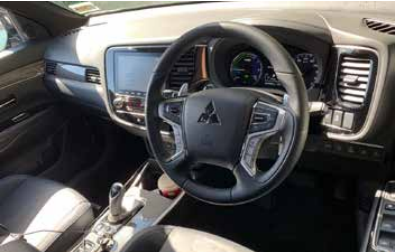
An 8” Smartphone Link display audio system is now standard across all models, featuring updated PHEV info screens.
Dual-zone air-conditioner control units allow all passengers climate of choice, and the instrument panel button layout has been revised.
Both XLS and VRX models get driver assist systems like adaptive cruise control, lane keeping and autonomous emergency braking, while the XLS gets a sunroof, full-leather and a power tailgate.
The XLS is now $52,990 and the VRX $57,990.
The Outlander is practical, but its slab-like dash design and piano black finish is dating a little.
The gauges show your power or region balance, and there is a centrally-mounted trip computer for showing your usage.
The front seats are very comfortable, with a soft cushion, yet enough side bolster to be supportive.
The leather feels nice and thick.
The rear seat offers good leg and headroom, although there is not enough width for three adults to be comfortable.
The boot is spacious – the PHEV lacks the third row of the petrol models – at 463 litres.
On the road, the Outlander feels much like any other SUV of its age, the steering is light, the ride is soft and comfortable, and there is body roll, though not to an uncomfortable level.
The electric drive feels particularly smooth, though you do need to drive a little gently to avoid kicking in the petrol motor.
When it does, it revs high for efficiency, so declares its arrival with a buzzy note.
In 2017 the NZ-new Outlander joined import models with DC fast charging – though it comes with a catch.
While it is Chademo and technically 50kW capable, in reality the small capacity and comparatively low voltage means it is hardly rapid.
Chargenet indicated to us you are really only charging at around 16kW – better than the onboard charger and AC, but not enough to make extended distances of electric travel viable.
Still – and as I said earlier – the Outlander PHEV is a pretty appealing package.
It offers a lot of specification for the money, and for most it offers just enough range to avoid the gas station in daily use.

Join the conversation