
Platooning has “no business case”, Daimler says

Daimler Trucks is ditching platooning technology after poor cost benefit results and ramping up autonomous developments instead.
Platooning was aimed at improving aerodynamics to save fuel through the electronic coupling of two or more trucks and reduce travelling distance.
The company has tested platooning for several years, especially in the United States where it was expected to have the greatest benefit.
However, results show that fuel savings, even in perfect platooning conditions, “are less than expected and that those savings are further diminished when the platoon gets disconnected and the trucks must accelerate to reconnect”, the company says.
“At least for U.S. long-distance applications, analysis currently shows no business case for customers driving platoons with new, highly aerodynamic trucks.
“Daimler Trucks will, of course, remain committed to all partner projects that are still ongoing,” Daimler says.
Instead, the company is shifting its focus on autonomous vehicles and is hiring 200 new engineers and robotics specialists with IT and programming skills.
It’s part of a US$570 million investment over the next few years with the goal of having a global presence of autonomous trucks within the next decade.
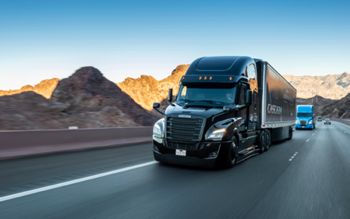 The main location is Daimler Trucks & Buses new Automated Truck Research & Development Center in Portland, Oregon. The center’s experts are dedicated to all aspects of developing, testing and validating automated vehicles.
In addition, the engineers in Portland work in close cooperation with their colleagues in the research and development centers at Daimler Trucks locations in Stuttgart, Germany, and Bangalore, India.
The new Freightliner Cascadia is already offering partially automated driving features and makes it the first-ever partially automated series production truck on North American roads. It made its world premiere at the recent 2019 Consumer Electronics Show (CES) in Las Vegas.
Daimler board of management member for trucks and buses Martin Daum says the company is pioneering automated trucking.
“In 2015, our Freightliner Inspiration Truck got the first road license ever for an automated commercial vehicle.
“Now we take automated trucking to the next level. We’re ready to launch the first partially automated new Freightliner Cascadia in 2019 and next, we tackle highly automated trucks.
“Highly automated trucks will improve safety, boost the performance of logistics and offer a great value proposition to our customers and thus contribute considerably to a sustainable future of transportation,” Daum says.

Join the conversation