
Used Nissan EV batteries in train crossings
Among the many uses for EV batteries no longer suited to cars you can add railway crossing devices.
The East Japan Railway Company (JR East) is trialling repurposed Nissan Leaf batteries, replacing emergency power supply units using lead-acid batteries to ensure rail signals and barriers can always operate properly.
Efforts to replace these with repurposed Nissan Leaf batteries began in January 2021 at the Atago railroad crossing on the Jōban Line, which runs through Minamisoma City in Fukushima Prefecture.
A Nissan Leaf’s lithium-ion battery retains 60% to 80% of its electricity storage capacity at the end of its life cycle in a car.
Therefore, by reusing used EV batteries, Nissan says it can direct remaining energy capacity elsewhere, such as into new replacement vehicle batteries or stationary batteries.
Nissan’s partner, 4R Energy Corporation, is responsible for the rail crossing effort.
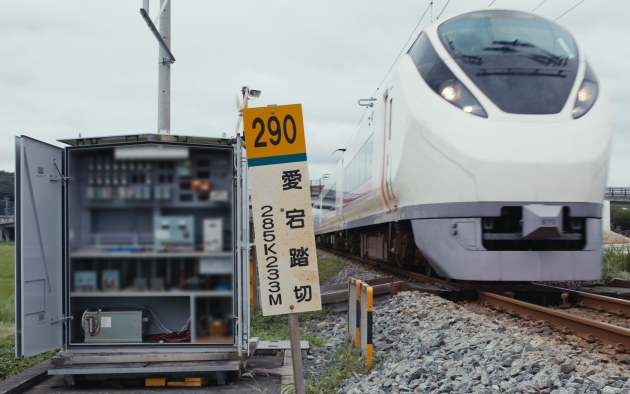
When it comes to emergency power supply, switching from lead-acid to repurposed EV lithium-ion batteries not only promotes sustainability, but also leads to improved performance from the battery itself, according to JR East research and development assistant chief researcher Kaito Tochihara.
Compared to lead-acid batteries, the reused lithium-ion variety requires only one-third of the charging time, are far more durable lasting on average 10 years, compared to three to seven years for a standard battery.
“With lead-acid batteries we have to periodically visit railroad crossings to check the state of charge and any deterioration,” Tochihara says.
“However, with repurposed lithium-ion batteries, there is a control system attached similar to an EV, so we can remotely check the battery’s status.
“This should lead to improved maintenance standards. This system also enables preventative maintenance by informing us of the battery’s status before its voltage becomes too low.”
4R Energy Corporation became operational in 2010 – the same year as the Nissan Leaf launch. Anticipating the widespread diffusion of EVs, the company’s aim was to make effective use of lithium-ion batteries after their service life in vehicles.
Each year the company’s factory in Namie, Fukushima Prefecture, receives thousands of used batteries, which they then repurpose.
If lightning strikes an EV, the electricity flows to the ground through the vehicle’s body, preventing the sudden abnormally high voltage (the lightning surge) from flowing into the battery.
However, at a railroad crossing the battery is connected by cables to devices such as barriers, alarms, and control equipment. If lightning strikes nearby, then the voltage can flow directly into the battery through those cables.
To enable the batteries to withstand such surges, modifications were applied to the battery’s control infrastructure from the development stage.
Additionally, before moving to the trial stage at a railroad crossing, JR East, 4R Energy Corporation, and third-party testing institutions held a variety of operational tests.
Plans include testing the batteries at other railroad crossings on the Jōban and Mito lines, which will also analyse the effect of lightning surges and other environmental factors on batteries across a wide range of areas.
“In autumn there are lots of lightning storms and typhoons,” Tochihara says.
“Railways powered by electricity come in various sizes. If we can confirm, in this trial, that repurposed batteries are safe for use on railways, then I think we can expect this initiative to be expanded, such as in wireless communications equipment.”

Join the conversation