
Video: Destination ahead – what we learned from a Tesla trip to the snow
 I was recently reading an opinion piece from the motoring section of one of the country’s major media outlets. While relatively balanced, it suggested that if you like to cover any kind of range or do more than idle down to the shops, look away – there is little to see in the electric vehicle market.
Now my experience is that is not the case. At least on paper. The Hyundai Kona will go over 400km on a charger and Tesla’s even further. So we set out to test – could you do more than pop down to the shops, and even get off perfect tarmac in an electric vehicle.
The test we chose was one that at this time of year is familiar to many kiwi families – the run to the mountain. A ski trip generally means loading a lot of people, a lot of gear and travelling a solid distance – often in inclement winter weather – for a week or weekend away.
Our test subject is arguably a little bit of overkill. Tesla threw us the shapely key to a Model X P100D for the drive – with a 100kWh battery, all-wheel drive, a 193kW front motor and monster 375kW rear motor and a $229,320 price tag before options.
We threw our type 2 to type 2 cable, a Chademo adaptor and some thick jackets in the deep boot of the X – having topped it up to close to 100% at Tesla’s new Auckland dealership and headed south – immediately impressed with the huge amount of visibility offered by the panoramic windscreen and raised ride height of the car.
The contextual search on the navigation system – type in the name of where you want to go, and it will use the internet to find the address for you itself – is fantastic. The whole 17-inch touchscreen setup, with its access to the vehicle settings, minor controls, trip computer data, audio system and cameras is brilliant. It does collect fingerprints, and it does take your eyes away from the road to look at lower buttons – but it is excellent.
The road south to Taupo is relatively straight and well-marked, so for most of it, we allowed AutoPilot to take a lot of the load. A lot has been written about the system and its self-driving ability, and it is excellent, though autonomous it is not. And in fairness, it is others who stick that label on the system and not Tesla. Flick the cruise control stick twice, and you feel the steering stiffen up as the car takes control.
On a motorway it works brilliantly, following the lines well and adapting for other traffic. On a typical two-lane road it is not bad and does a reasonable job even with imperfect lines. The downside on these roads is the system is sensitive to any form of input, switching off when you respond a little more than it wants you to bends.
A footnote: We tried the system again a month later in Australia and found it far less sensitive – one of the advantages of Tesla’s over the air software updates.
Four hours and 278km later we rolled into Taupo with 12% left on the battery. Wait, according to the Tesla’s NEDC rating of 540km, we should have arrived with nearly 50% gone. First lesson of EV travel: official scores are in perfect conditions and mostly in the city, not loaded up with luggage, enjoying the performance, air-conditioning and heated seats with some Sylvan Esso on repeat. I look at it that we made it between two distant superchargers with a safety margin while using a car as intended. That is a design win as far as I am concerned.
We did however, decide to skip the Supercharger till the morning. It was late, and a warm barstool awaited us at the Hilton. We got a surprise on check-in, however, with the staff excited to see a Tesla and quickly shuffling our room to be close to one of the two Tesla destination charges in the basement. Having the car top up overnight while you sleep is far superior to having to fast charge – even with the speed of DC charging that is an hour of your life you would love to have back.
The next day dawned wet, so we battened down and headed for Ohakune, stopping at Tokaanu springs for a dip. While preparing filming equipment here, I began to appreciate the falcon wing doors for the easy access they provided to the second row and the shelter you get too. They attract attention when you open them, though keep clear as they are a little too sensitive to obstructions and like to halt progress if someone is too close.
Up over the hills to the central plateau, the performance and handling of the X impressed. I have been slightly critical of the S, and how it feels a little heavy and imprecise compared to other large performance sedans. The X retains a lot of the S’s ability, and so when compared against its competition is brilliant. It feels solid and stable, the ride on the air suspension is excellent, body roll is well controlled, and there are acres of grip. To me, in context, the X is the better car.
We arrived in Ohakune, having made a massive step in altitude nearly 50% down in battery charge, and then ate a little further into it with a few tests of the X’s hilarious – ludicrous even – sub-4-second 0-100kmh sprint time.
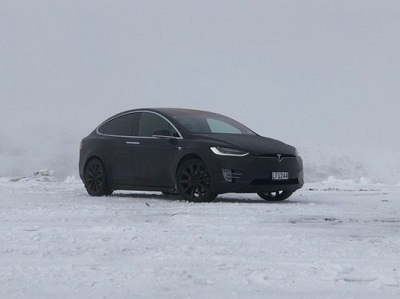
Now, we wanted to see what the X would do when presented with something other than tarmac, and Ruapehu delivered. A drizzle at the base of the mountain indicated worse weather further up, and as we climbed the mountain, watching the range drop at a significant rate, this was proved right with snow beginning to fall.
All-wheel drive meant we could, somewhat smugly, bypass the chain station, and soon we were cautiously driving across slush, then crispy ice and snow. Again smug, we bypassed the entrances to the parking lots and went all the way to the top of the road – where the shuttle buses get to go.
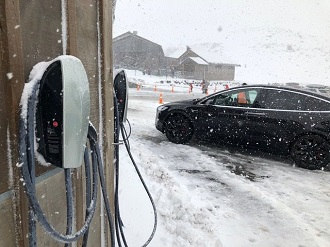
Why? Ruapehu Alpine Lifts have thoughtfully installed four Tesla chargers here – and they are the best parks on the mountain. It’s a very short walk from them to the lifts, and while you ski your car can be sucking some of that sweet destination charger energy. Sadly, they are still being provisioned, so we headed back down with a battery that was not going to get us back to the Superchargers in Taupo.
Some downhill regen though and we made it with range to spare to the Chargenet 50kW unit at National Park. An hour plugged in here – and a coffee and pie around the corner – and we were fuelled to Taupo for a short Supercharger session before a relatively short run to Rotorua.
Now with their prices and clientele, it’s probably little surprise that the Hilton had a destination charger, but there appears to be plenty of other more reasonable accommodation offering the feature. For us, this was at the Ibis, and we were set for another night charge while we slept – except another Tesla owner had plugged in and despite full before bedtime left the car there. Come on people! A visit to the Unison unit around the corner sorted us out.
So what did we learn from the trip? Well, it reinforced our previous experience that with little planning road trips in electric vehicles are easy, that the Model X is a great vehicle, that falcon wing doors are cool and that AutoPilot makes driving long distances so much easier.
While using the SuperChargers is cool and convenient, our surprising lesson from the trip is that level 2 or destination charging is far better and more useful in real life. Being able to charge while not having to remain near the vehicle – ideally, while you sleep – is a far better solution than waiting. And there is more out there than you think!

Join the conversation