
Video: Renault trialling large-scale V2G
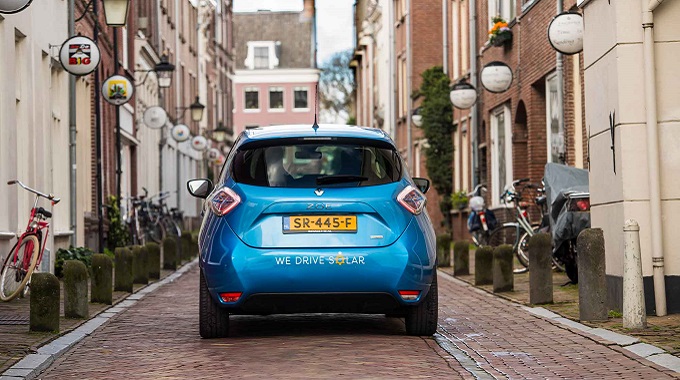
Groupe Renault is piloting vehicle-to-grid (V2G) charging in electric vehicles on a large scale in what it claims as a world first.
A European EV leader, the company has just begun the first large-scale pilot schemes in alternating-current, V2G charging starting in the Netherlands (Utrecht) and Portugal (Porto Santo Island). France, Germany, Switzerland, Sweden and Denmark will follow.
Technology using an onboard reversible charger can greatly reduce the related cost of charging terminals as it just requires a simple, inexpensive adaptation of the existing terminals, Groupe Renault says.
A fleet of 15 Zoe vehicles with V2G charging will be introduced in Europe during 2019 to lay the groundwork for future standards.
“Vehicle-to-grid charging is a key pillar of the smart electric ecosystems that Groupe Renault has set up,” its EV director Gilles Normand says.
“We have chosen onboard technology that also optimises the cost of recharging stations and thus facilitate a large-scale development.”
V2G, also called reversible charging, modulates the charging and discharging of EV batteries in accordance with users’ needs and the grid’s supply of available electricity.
Charging reaches its maximum level when the electricity supply exceeds demand, notably during peaks in production of renewable energy.
But vehicles can inject electricity into the grid during consumption peaks.
EVs can therefore serve as temporary energy storage units and become key drivers in the development of renewable energy.
In this way, the electricity grid optimises the supply of local renewable energy and reduces infrastructure costs. At the same time, customers enjoy greener, more economical consumption of electricity and are financially rewarded for serving the electricity grid, Renault says.
Reversible charging will be piloted in several projects (electric ecosystems or mobility services) through seven countries and alongside various partners.
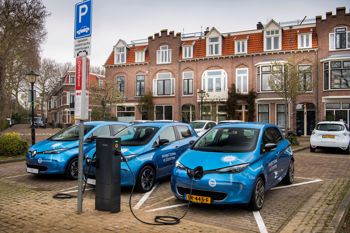
The aim is to measure large-scale feasibility and potential gains. In particular, the pilot schemes will help Groupe Renault to underline the technical and economic advantages of an onboard solution in EVs, demonstrate the value of services provided for the local and national electricity grid – such as encouraging solar and wind energy consumption, checking the grid’s frequency or tension, and reducing infrastructure costs – and working on regulatory frameworks around mobile energy storage.
Another aim is to establish common standards, the basic requirement for an industrial-scale roll-out.
Visit https://easyelectriclife.groupe.renault.com for more information.Groupe Renault is piloting vehicle-to-grid (V2G) charging in electric vehicles on a large scale it what it claims as a world first.
A European EV leader, the company has just begun the first large-scale pilot schemes in alternating-current, V2G charging starting in the Netherlands (Utrecht) and Portugal (Porto Santo Island). France, Germany, Switzerland, Sweden and Denmark will follow.
Technology using an onboard reversible charger can greatly reduce the related cost of charging terminals as it just requires a simple, inexpensive adaptation of the existing terminals, Groupe Renault says.
A fleet of 15 Zoe vehicles with V2G charging will be introduced in Europe during 2019 to lay the groundwork for future standards.
“Vehicle-to-grid charging is a key pillar of the smart electric ecosystems that Groupe Renault has set up,” its EV director Gilles Normand says.
“We have chosen onboard technology that also optimises the cost of recharging stations and thus facilitate a large-scale development.”
V2G, also called reversible charging, modulates the charging and discharging of EV batteries in accordance with users’ needs and the grid’s supply of available electricity.
Charging reaches its maximum level when the electricity supply exceeds demand, notably during peaks in production of renewable energy.
But vehicles can inject electricity into the grid during consumption peaks.
EVs can therefore serve as temporary energy storage units and become key drivers in the development of renewable energy.
In this way, the electricity grid optimises the supply of local renewable energy and reduces infrastructure costs. At the same time, customers enjoy greener, more economical consumption of electricity and are financially rewarded for serving the electricity grid, Renault says.
Reversible charging will be piloted in several projects (electric ecosystems or mobility services) through seven countries and alongside various partners.
The aim is to measure large-scale feasibility and potential gains. In particular, the pilot schemes will help Groupe Renault to underline the technical and economic advantages of an onboard solution in EVs, demonstrate the value of services provided for the local and national electricity grid – such as encouraging solar and wind energy consumption, checking the grid’s frequency or tension, and reducing infrastructure costs – and working on regulatory frameworks around mobile energy storage.
Another aim is to establish common standards, the basic requirement for an industrial-scale roll-out.
Visit easyelectriclife.groupe.renault.com for more information.

Join the conversation