
Video: Toyota FCEV moon-bound
https://www.youtube.com/watch?time_continue=3&v=1kd2nFHAAtU
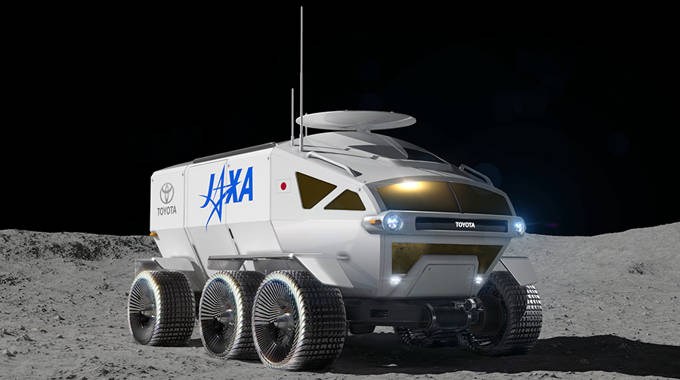
Toyota aims to put a fuel cell electric vehicle (FCEV) on the moon by about 2029.
The Japan Aerospace Exploration Agency (JAXA) and Toyota Motor Corporation have agreed to consider collaborating on international space exploration, with a manned and pressurised FCEV lunar rover as a first step.
Even with the limited amount of energy that can be transported to the moon, the rover would have a lunar-surface cruising range of more than 10,000km.
A concept proposal envisages the six-wheel FCEV being six metres long by 5.2m wide and about 3.8m high (about the size of two microbuses), accommodating two people (four in an emergency) with 13 cubic metres of living space.
Comparing Earth’s car industry with space, Toyota president Akio Toyoda says the industry is constantly thinking about its role and shares the same aspirations for international space exploration.
“I am extremely happy that, for this project, expectations have been placed on the thus-far developed durability and driving performance of Toyota vehicles and on our fuel cell environmental technologies.”
Toyoda says that in responding to such matters as environmental issues of global scale, “the concept of ‘home planet’, from which all of us come, will become a very important concept”.
Toyota executive vice president Shigeki Terashi says the company believes that achieving a sustainable mobility society on Earth will involve the coexistence and widespread use of electrified vehicles, such as hybrid electric vehicles, plug-in hybrid electric vehicles, battery electric vehicles, and fuel cell electric vehicles.
“For electrification, fuel cell batteries represent an indispensable technology.
“As an engineer, there is no greater joy than being able to participate in such a lunar project by way of Toyota’s car-making and, furthermore, by way of our technologies related to electrified vehicles, such as fuel cell batteries, and our technologies related to autonomous and automated driving.
“Fuel cells, which use clean power-generation methods, emit only water, and, because of their high energy density, they can provide a lot of energy, making them especially suited for the project being discussed with JAXA.”
JAXA president Hiroshi Yamakawa says; “We aim to contribute through leading Japanese technologies that can potentially generate spin-off benefits. Manned rovers with pressurised cabins are an element that will play an important role in full-fledged exploration and use of the lunar surface.”
Perhaps it will be called the Toyota Lunar Cruiser?

Join the conversation